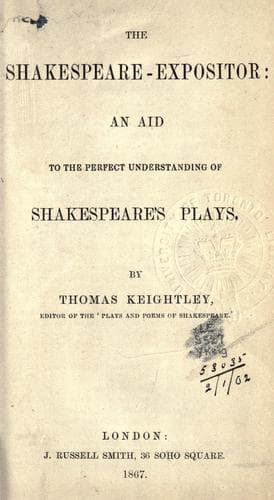
The Shakespeare-Expositor: An Aid to the Perfect Understanding of Shakespeare's Plays — John Shaqi
The Shakespeare-Expositor: An Aid to the Perfect Understanding of Shakespeare's PlaysKeightley, Thomas
General
The Shakespeare-Expositor: An Aid to the Perfect Understanding of Shakespeare's Plays
Keightley, Thomas
Drama -- Outlines, syllabi, etc.; Shakespeare, William, 1564-1616 -- Outlines, syllabi, etc.
"As Plautus and Seneca are accounted the best for comedy and tragedy
among the Latines, so Shakespeare among the English is the most
excellent in both kinds for the stage. For comedy witness his Gentlemen
of Verona, his Errors, his Love Labour's Lost, his Love Labour's Won,
his Midsummer's Night Dream, and his Merchant of Venice; for tragedy
his Richard II., Richard III., Henry IV., King John, Titus Andronicus,
and his Romeo and Juliet."
Critics have hence inferred that these were Shakespeare's only plays
written before 1598; but they have not observed that, moved probably
by a love of symmetry and uniformity, Meres has given just half a
dozen of each; and as in reality there were only five of our author's
original tragedies then in being, he adds a play to which he could at
most have only given a few touches, omitting the two Parts of Henry
VI., for which he had done a vast deal more. In like manner he seems
in his list of comedies to have omitted The Taming of the Shrew, which
must be regarded as the least original of the comedies, and which the
language and verse prove to belong to this period of his plays. It is
generally agreed that Shakespeare never himself gave a play to the
press; those, then, of which there are editions published during his
lifetime, must have been printed from copies surreptitiously obtained,
perhaps from the prompter. Hence their inaccuracies and imperfections.
There is a theory indeed that they may have been taken down in
short-hand during representation; but this theory seems only tenable in
a single instance, Henry V., and the practice must have found a strong
obstacle in the metre, to speak of no other difficulty. My opinion
is that when once a copy of a play had been obtained and printed, it
became the groundwork of all the subsequent editions which were printed
from it, sometimes with corrections, made by the printer himself or by
some man of letters employed by him for the purpose--except in such
cases as Romeo and Juliet, or The Merry Wives, where the author had
himself "corrected, augmented, and amended" his play. I may add that
our forefathers, like the Orientals, had not our ideas about adhering
strictly to the text of an author. If they thought they could improve
it, they never hesitated to do so. I will now briefly state what is of
most importance respecting the editions, the dates, and the origins of
these immortal dramas.
COMEDIES.
THE COMEDY OF ERRORS.
_Edition._ Only in the folio, 1623.
_Date._ As it is mentioned by Meres it must be anterior to 1598. It was
probably Shakespeare's first original piece. From the plain allusion
(III. 2) to the civil war in France, it must have been written before
February 1594, in which year Henry IV. was crowned. I have shown above
that it could not have been acted earlier than 1593.
Public-domain text, read in full here on John Shaqi.
Reviews
Reviews
No reviews yet
Be the first to share your thoughts on this work.
Join the Discussion
Join the discussion
Sign in to leave a comment or review.
Sign InorCreate an account