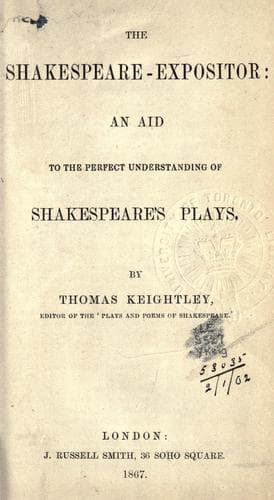
The Shakespeare-Expositor: An Aid to the Perfect Understanding of Shakespeare's PlaysKeightley, Thomas
General
The Shakespeare-Expositor: An Aid to the Perfect Understanding of Shakespeare's Plays
Keightley, Thomas
Drama -- Outlines, syllabi, etc.; Shakespeare, William, 1564-1616 -- Outlines, syllabi, etc.
_Origin._ It is manifestly founded on the Menæchmi of Plautus; but
Shakespeare hardly went to the original. He may have merely got an
account of that piece from some learned friend; and there was a piece
named The Historie of Error, which was played at Hampton Court before
the Queen, on New Year's day 1576-77, which may have been formed on
the Menæchmi. The proper title of this play seems to have been simply
Errors, and The Comedy of Errors is like The Tragedy of Macbeth, &c.
THE TWO GENTLEMEN OF VERONA.
_Edition._ Only in the folio, 1623.
_Date._ Anterior to 1598 as it is in Meres's list. The critics have
not observed that the resemblance is so strong between Act III. Sc. 1
of this play, and Act I. Sc. 2 of Lyly's Midas, that the one must have
been taken from the other. In my opinion our poet was the borrower, as
his scene is so superior to Lyly's. Now Midas was printed in 1592; but
Shakespeare, it may be said, may have seen the play acted, or he may
have written that scene, and added it to his play after he had read
Lyly's; so the present comedy might have been written before 1592.
This, however, I have shown to be at the least very unlikely. Though in
my edition of the Plays I have given, as here, precedence to The Comedy
of Errors, I do not feel at all certain upon the point, and would by no
means assert that this is not rather "the first heir of his [dramatic]
invention."
_Origin._ The plot seems to have been, in the main, of our poet's
own invention; though what relates to Proteus and Julia may have
been suggested, mediately or immediately, by the story of Felix and
Felismena in the Diana of Montemayor. Indeed the points of resemblance
are such that I feel confident the poet must have been acquainted with
that part of the Diana; and yet it was not translated till 1598. Might
he not have learned it from some one who had read the work in Spanish?
LOVE'S LABOUR'S LOST.
_Editions._ 4to, 1598; in the folio, 1623.
_Date._ We have no means of ascertaining the exact time of its
composition; but from internal evidence we must regard it as one of our
author's earliest pieces, yet, I think, later than those I have placed
before it.
_Origin._ It is apparently wholly our poet's own invention, as no
novel, play, or anything else at all resembling it has been discovered.
ALL'S WELL THAT ENDS WELL.
_Edition._ Only in the folio, 1623.
Public-domain text, read in full here on John Shaqi.
Reviews
Reviews
No reviews yet
Be the first to share your thoughts on this work.
Join the Discussion
Join the discussion
Sign in to leave a comment or review.
Sign InorCreate an account