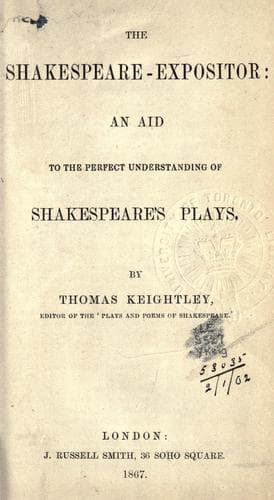
The Shakespeare-Expositor: An Aid to the Perfect Understanding of Shakespeare's PlaysKeightley, Thomas
General
The Shakespeare-Expositor: An Aid to the Perfect Understanding of Shakespeare's Plays
Keightley, Thomas
Drama -- Outlines, syllabi, etc.; Shakespeare, William, 1564-1616 -- Outlines, syllabi, etc.
_Date._ Meres, as we have seen, terms one of Shakespeare's comedies
"Love Labour's Won." Among our author's extant comedies there is none
with that title, and we have no reason whatever for supposing any
original play of his to be lost; while on the other hand the subject
of the present play accords most accurately with that title. It has
therefore been conjectured, with great probability, that this is one
of Shakespeare's early plays, which he altered and improved at a later
period, giving it at the same time a new title. We can certainly
discern in it the style and mode of composition of two different
periods--the riming scenes, for instance, belonging to the earlier
one. It is to be observed of these riming scenes, that they only occur
in the three preceding plays, and in Romeo and Juliet, in all which
plays soliloquies, letters, &c. are in stanzas--like the sonnets in
Spanish plays; and the very same is the case in the present play, and
in it alone of the later ones; whence we may fairly conclude that it
belonged to the early period. The second act seems to retain, both in
the serious and the comic scenes, much of the original play unaltered;
and every one must be struck with the resemblance of the style in it to
that of Love's Labour's Lost.
_Origin._ The tale of Giletta di Narbona in Boccaccio's Decameron,
which Shakespeare may have read in the original, or in the translation
in Painter's Palace of Pleasure. The comic scenes are, of course, our
author's own, as usual.
A MIDSUMMER-NIGHT'S DREAM.
_Editions._ 4to (by Fisher), 1600; 4to (by Roberts), 1600; in the
folio, 1623.
_Date._ Anterior to 1598, as it is mentioned by Meres. I _do_ think
that in Act II. Sc. 1 there is an allusion to the state of the weather
in the summer of 1594, and that Shakespeare may have been writing this
play at that very time. I therefore incline to give that year, or
1595, as the date of its composition.
_Origin._ Purely and absolutely the whole the poet's own invention. He
was well read in Chaucer, in Golding's Ovid, and in North's Plutarch,
where he got the names of his characters and some circumstances.
THE TAMING OF THE SHREW.
_Edition._ Only in the folio, 1623.
_Date._ We have no means of ascertaining the exact date of this play;
but the style proves it to belong to Shakespeare's early period. The
reason of its omission by Meres has been already given.
_Origin._ It is a _rifacimento_ of an anonymous play, first printed
in 1594, though perhaps written and acted some time earlier, and
termed "The Taming of a Shrew," and it may be anterior to the
Midsummer-Night's Dream; the date 1594 would seem to have some
connexion with both plays. The incident of the Pedant personating
Vincentio was taken from The Supposes, a translation by Gascoigne of
Ariosto's I Suppositi.
THE MERCHANT OF VENICE.
Public-domain text, read in full here on John Shaqi.
Reviews
Reviews
No reviews yet
Be the first to share your thoughts on this work.
Join the Discussion
Join the discussion
Sign in to leave a comment or review.
Sign InorCreate an account