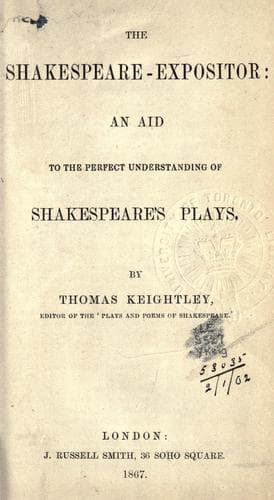
The Shakespeare-Expositor: An Aid to the Perfect Understanding of Shakespeare's PlaysKeightley, Thomas
General
The Shakespeare-Expositor: An Aid to the Perfect Understanding of Shakespeare's Plays
Keightley, Thomas
Drama -- Outlines, syllabi, etc.; Shakespeare, William, 1564-1616 -- Outlines, syllabi, etc.
_Editions._ 4to (by Roberts), 1600; 4to (by Heyes), 1600; in the folio,
1623. The two 4tos are in effect the same; for Heyes's was printed
by J. R., _i.e._ James Roberts, who probably had contrived to get a
transcript from the copy in the theatre, and then may have made some
arrangement with Heyes for the publication.
_Date._ It is in Meres's list, and it was entered by Roberts in the
Stationers' Registers 22nd July 1598; so that it was probably first
acted in that or the preceding year. It is, I think, certainly later
than any of the preceding comedies.
_Origin._ The remote origin of the incidents both of the bond and
of the caskets is the Gesta Romanorum portions of which had been
translated and published by Robinson in 1577. The incident of the bond
is also in Il Pecorone of Ser Giovanni Fiorentino, first printed in
1558, and which Shakespeare may have read. There was also a ballad
on the subject, in Percy's Reliques, with which he may have been
acquainted.
AS YOU LIKE IT.
_Edition._ Only in the folio, 1623.
_Date._ It is posterior to 1598, as Meres does not mention it, and
was entered in the Stationer's Registers, August 4, 1600, by the
booksellers Wise and Aspley; but for some reason, which we cannot now
discover, they did not print it.
_Origin._ It is founded on Lodge's novel of Rosalynde, of which the
chief origin was The Coke's Tale of Gamelyn, ascribed, but wrongly,
to Chaucer. The characters of Jaques, Touchstone, and Audrey, and of
course all the comic scenes, are Shakespeare's own.
MUCH ADO ABOUT NOTHING.
_Editions._ 4to, 1600; in the folio, 1623.
_Date._ Not being mentioned by Meres, it is posterior to 1598; and as
it is said, in the title-page of the 4to, that "it hath been sundry
times publicly acted," it may have been written in 1598, and may be
older than As You Like It; but we have no means of deciding.
_Origin._ The story of Ariodante and Ginevra in the Orlando Furioso,
which Shakespeare may have read either in the original or in Sir
John Harington's translation, published in 1591. The story had also
been translated by Beverley and Turberville; and there was a play
on it, performed before the Queen on Shrove Tuesday 1582-83; so
that it was well known. Shakespeare's other authority was the novel
of Timbreo di Cardona, &c., in Bandello, in which occur the names
_Pietro di Aragona_, _Messina_, and Felicia _Lionata_, and with which
therefore Shakespeare must have been acquainted. As there was no known
translation of it, save a French one in Belleforest's _Histoires
Tragiques_, I am of opinion that Shakespeare had read the original
Italian. It need hardly be added that all the comic scenes and
characters are our author's own.
THE MERRY WIVES OF WINDSOR.
_Editions._ 4to, 1602; 4to, 1619; in the folio, 1623.
Public-domain text, read in full here on John Shaqi.
Reviews
Reviews
No reviews yet
Be the first to share your thoughts on this work.
Join the Discussion
Join the discussion
Sign in to leave a comment or review.
Sign InorCreate an account