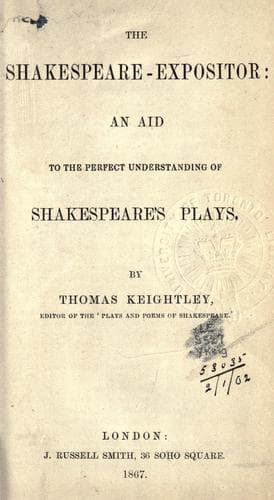
The Shakespeare-Expositor: An Aid to the Perfect Understanding of Shakespeare's PlaysKeightley, Thomas
General
The Shakespeare-Expositor: An Aid to the Perfect Understanding of Shakespeare's Plays
Keightley, Thomas
Drama -- Outlines, syllabi, etc.; Shakespeare, William, 1564-1616 -- Outlines, syllabi, etc.
It would seem that for the first few years he was merely an actor; and
if the Ellesmere Papers, published by Mr. Collier, be genuine, he had
in 1589 become a sharer in the Blackfriars Theatre. Before this date he
may have begun to try his hand at making additions and alterations in
the plays of others. Of these we seem to have examples in the Second
and Third Parts of King Henry VI.; and there is a manifest allusion
to this practice of his in the following passage of Green's Groat's
Worth of Wit, bought with a Million of Repentance, published after
his death in 1592. Green is addressing his fellow dramatists Marlow,
Peele, and others; and he says, "There is an upstart crow, beautified
with our feathers, that with his _Tygre's heart wrapt in a player's
hyde_, supposes he is as well able to bombast out a blank verse as the
best of you; and, being an absolute Johannes Factotum, is in his own
conceit the only _Shake-scene_ in a country." Here the allusion to
Shakespeare's name is quite plain, and the line in italics is a parody
on one in one of the plays which he appears to have thus treated. As
this allusion seems to have caused just offence, Chettle, who had given
Green's work to the world, took occasion shortly after in a work of
his own, his Kind-hart's Dream, to make an apology, in which he says
of Shakespeare, "Myself have seen his demeanour, no less civil than he
excellent in the quality he professes. Besides, divers of worship have
reported his uprightness of dealing, which argues his honesty, and his
facetious grace in writing that approves his art." We thus see that
Shakespeare was regarded as an excellent player (for _quality_ then
answered to _profession_ at the present time), as an elegant writer
(_facetious_ being employed in its classic sense), and as an upright
and honourable man, and further, perhaps, as moving in what we should
term good society.
Moreover this work of Chettle's, published at the end of 1592 or
beginning of 1593, furnishes what I regard as a proof that Shakespeare
had not at that time brought an original piece on the stage; for
speaking of Green he says, "He was of singular pleasance, the very
supporter, and--to no man's disgrace be this intended--_the only
comedian of a vulgar writer in this country_;" of which last words the
plain meaning is, that Green had as yet been the only tolerable writer
of English comedy. Now we have sufficient means for judging of Green's
comic powers; and surely no man in his senses would have ventured to
write these words, had he been ever so prejudiced, if Shakespeare had
already produced the Comedy of Errors or The Two Gentlemen of Verona.
We may therefore venture to assert that neither of these plays was
acted earlier than 1593.
Public-domain text, read in full here on John Shaqi.
Reviews
Reviews
No reviews yet
Be the first to share your thoughts on this work.
Join the Discussion
Join the discussion
Sign in to leave a comment or review.
Sign InorCreate an account