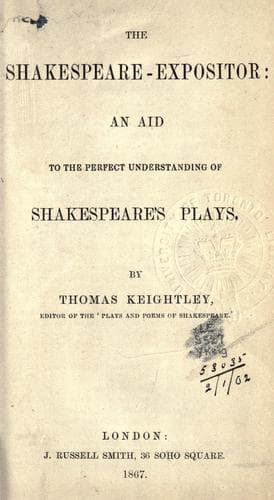
The Shakespeare-Expositor: An Aid to the Perfect Understanding of Shakespeare's Plays — John Shaqi
The Shakespeare-Expositor: An Aid to the Perfect Understanding of Shakespeare's PlaysKeightley, Thomas
General
The Shakespeare-Expositor: An Aid to the Perfect Understanding of Shakespeare's Plays
Keightley, Thomas
Drama -- Outlines, syllabi, etc.; Shakespeare, William, 1564-1616 -- Outlines, syllabi, etc.
We may here, by the way, notice some curious coincidences between
Shakespeare and the great comic poet of France, Molière. There is some
reason to suppose that both of them were originally connected with the
law; they both went on the stage at, we may say, the age of twenty, or
a little later. Shakespeare was in his thirtieth year when he produced
his first original play, Molière in his thirty-second when he wrote
L'Etourdi; but he had previously given some short pieces. Finally,
the former died at the close, the latter at the commencement of his
fifty-second year.
The allusion to the poet's literary character in Kindhart's Dream was
in all probability to his Venus and Adonis, which was published in
1593, but which may, as was the custom in those days, have previously
circulated in manuscript among his "private friends;" or it may have
been to his Sonnets, which, as we shall presently see, thus circulated
at this time. It is impossible to say when this poem was written; but
there certainly is no necessity for supposing, with Mr. Collier, that
it was composed at Stratford. Shakespeare's mind easily retained the
requisite rural imagery; and with his power of rapid composition and
command of language, a very few weeks would suffice at any time for
its production. This poem, which he terms his "unpolished lines," and
"the first heir of my invention," was dedicated to Henry Wriothesly,
Earl of Southampton. It met with general applause, and was followed,
in 1594, by Lucrece, also dedicated to the same accomplished nobleman.
The dedication, commencing with "The love I dedicate to your lordship
is without end," would seem to intimate some degree of friendship on
both sides; and as Shakespeare's private character, as we have seen,
appears to have been most respectable, and Southampton was a well-known
admirer of the drama, some kind of intimacy between him and the poet
is not by any means improbable. There is also nothing incredible in
what Rowe says had been "handed down by Sir William Davenant," of Lord
Southampton's having "at one time given him £1000 to enable him to
go through with a purchase which he heard he had a mind to." But the
amount must be much exaggerated; for none of Shakespeare's purchases
that we hear of ever came to so large a sum. Mr. Collier thinks,
with some probability, that, as it appears that the Globe Theatre on
the Bankside was built in 1594 by the company to which Shakespeare
belonged, Lord Southampton may have given him as much money as his
share of the cost came to, which could not well have been more than a
few hundred pounds.
Public-domain text, read in full here on John Shaqi.
Reviews
Reviews
No reviews yet
Be the first to share your thoughts on this work.
Join the Discussion
Join the discussion
Sign in to leave a comment or review.
Sign InorCreate an account