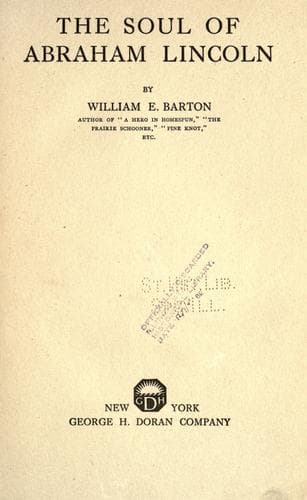
The Soul of Abraham LincolnBarton, William E. (William Eleazar)
Religion
The Soul of Abraham Lincoln
Barton, William E. (William Eleazar)
Lincoln, Abraham, 1809-1865 -- Religion; Presidents -- United States -- Biography
The Lincoln family was poor, even as poverty was estimated in the
backwoods. Lincoln himself was painfully impressed with the memory of
it, and Herndon and Lamon, who understood it better than most of his
biographers, felt both for themselves and for Lincoln the pathos of his
descent from "the poor whites"; but there is no evidence that Lincoln
felt this seriously at the time. His melancholy came later, and was
not the direct heritage of his childhood poverty. Life had its joys
for families such as his. Poverty was accepted as in some sort the
common lot, and also as a temporary condition out of which everybody
expected sometime to emerge. Meantime the boy Abraham Lincoln had not
only the joy of going to mill and to meeting, but also the privilege
of an occasional frolic. We know of one or two boisterous weddings
where he behaved himself none too well. Besides these there were other
unrecorded social events on Pigeon Creek where the platter rolled
merrily and he had to untangle his long legs from under the bench and
move quickly when his number was called or pay a forfeit and redeem
it. He played "Skip-to-My-Lou" and "Old Bald Eagle, Sail Around," and
"Thus the Farmer Sows His Seed," and he moved around the room singing
about the millwheel and had to grab quickly when partners were changed
or stand in the middle and be ground between the millstones. As large a
proportion of people's known wants were satisfied on Pigeon Creek as on
some fashionable boulevards. We need not seek to hide his poverty nor
idealize it unduly; neither is it necessary to waste overmuch of pity
upon people who did not find their own condition pitiable.
* * * * *
What kind of man had been produced in this environment and as the
result of the conditions of his heredity and of his inherent qualities?
What do we know about the Abraham Lincoln who in 1830 took simultaneous
leave of Indiana and his boyhood, and entered at once upon his manhood
and the new State, that, twin-born with him, was waiting his arrival?
He was a tall, awkward, uncouth backwoodsman, strong of muscle,
temperate and morally clean. He had physical strength and was not a
bully; was fond of a fight but fought fairly and as a rule on the side
of weakness and of right. He was free from bad habits of all kinds, was
generous, sympathetic, and kind of heart. He was as yet uninfluenced
by any women except his own dead mother and his stepmother. He was
socially shy, and had not profited greatly by the meager lessons in
social usage which had been taught in Andrew Crawford's school. He was
fond of cock-fighting and of boisterous sports, and had a sufficient
leadership to proclaim himself "the big buck of the lick" and to have
that declaration pass unchallenged.
Public-domain text, read in full here on John Shaqi.
Reviews
Reviews
No reviews yet
Be the first to share your thoughts on this work.
Join the Discussion
Join the discussion
Sign in to leave a comment or review.
Sign InorCreate an account