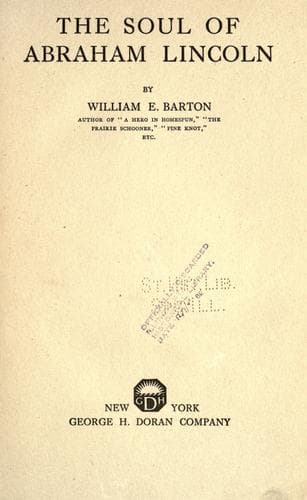
The Soul of Abraham LincolnBarton, William E. (William Eleazar)
Religion
The Soul of Abraham Lincoln
Barton, William E. (William Eleazar)
Lincoln, Abraham, 1809-1865 -- Religion; Presidents -- United States -- Biography
He could read, write, and cipher, and was eager for learning. He was
ambitious, but his ambitions had no known focus. He was only moderately
industrious, but could work hard when he had to do so. He had some
ambition to write and to speak in public, but as yet he had little
idea what he was to write or speak about. He was a great, hulking
backwoodsman, with vague and haunting aspirations after something
better and larger than he had known or seemed likely to achieve.
What do we know about the spiritual development of the young Boanerges
who grew almost overnight in his eleventh year into a six-footer and
was so wearied by the effort that he was slow of body and mind and was
thought by some to be lazy ever afterward?
We know the books he read--the Bible, _Pilgrim's Progress_, _Æsop's
Fables_, _Robinson Crusoe_, and Weems' _Life of Washington_. It was a
good collection, and he made the most of it. Sarah Bush Lincoln noted
that while he did not like to work he liked to read, and she said, "I
induced my husband to permit Abe to study" (Herndon, I, 36).
John Hanks said of him, "He kept the Bible and _Æsop's Fables_ always
within reach, and read them over and over again."
Sarah Bush did not claim that he showed any marked preference for the
Bible. Lamon quotes her as saying, "He seemed to have a preference for
the other books" (_Life_, pp. 34, 486). But he certainly read the Bible
with diligence, as his whole literary style shows. Indeed, if we had
only his coarse "First Chronicles of Reuben," which we could heartily
wish he had never written, and whose publication in Herndon's first
edition was one of the chief reasons for an expurgated edition,[10] we
should know that even then Abe Lincoln, rough, uncouth and vulgar as he
was, was modeling his style upon the Bible.
We are told that when he went to church he noted the oddities of the
preachers and afterward mimicked them (Lamon: _Life_, pp. 55, 486).
This might have been expected, for two reasons. First, he had a love of
fun and of very boisterous fun at that; secondly, he had a fondness for
oratory, and this was the only kind of oratory he knew anything about.
Public-domain text, read in full here on John Shaqi.
Reviews
Reviews
No reviews yet
Be the first to share your thoughts on this work.
Join the Discussion
Join the discussion
Sign in to leave a comment or review.
Sign InorCreate an account