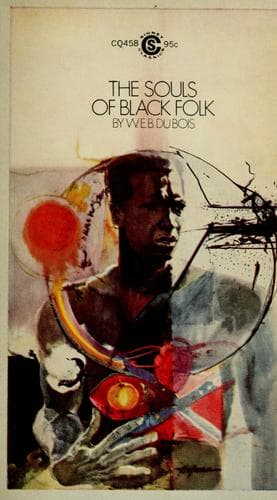
The Souls of Black FolkDu Bois, W. E. B. (William Edward Burghardt)
History
The Souls of Black Folk
Du Bois, W. E. B. (William Edward Burghardt)
African Americans
The act of 1866 gave the Freedmen’s Bureau its final form,—the form by
which it will be known to posterity and judged of men. It extended the
existence of the Bureau to July, 1868; it authorized additional
assistant commissioners, the retention of army officers mustered out of
regular service, the sale of certain forfeited lands to freedmen on
nominal terms, the sale of Confederate public property for Negro
schools, and a wider field of judicial interpretation and cognizance.
The government of the unreconstructed South was thus put very largely
in the hands of the Freedmen’s Bureau, especially as in many cases the
departmental military commander was now made also assistant
commissioner. It was thus that the Freedmen’s Bureau became a
full-fledged government of men. It made laws, executed them and
interpreted them; it laid and collected taxes, defined and punished
crime, maintained and used military force, and dictated such measures
as it thought necessary and proper for the accomplishment of its varied
ends. Naturally, all these powers were not exercised continuously nor
to their fullest extent; and yet, as General Howard has said, “scarcely
any subject that has to be legislated upon in civil society failed, at
one time or another, to demand the action of this singular Bureau.”
To understand and criticise intelligently so vast a work, one must not
forget an instant the drift of things in the later sixties. Lee had
surrendered, Lincoln was dead, and Johnson and Congress were at
loggerheads; the Thirteenth Amendment was adopted, the Fourteenth
pending, and the Fifteenth declared in force in 1870. Guerrilla
raiding, the ever-present flickering after-flame of war, was spending
its forces against the Negroes, and all the Southern land was awakening
as from some wild dream to poverty and social revolution. In a time of
perfect calm, amid willing neighbors and streaming wealth, the social
uplifting of four million slaves to an assured and self-sustaining
place in the body politic and economic would have been a herculean
task; but when to the inherent difficulties of so delicate and nice a
social operation were added the spite and hate of conflict, the hell of
war; when suspicion and cruelty were rife, and gaunt Hunger wept beside
Bereavement,—in such a case, the work of any instrument of social
regeneration was in large part foredoomed to failure. The very name of
the Bureau stood for a thing in the South which for two centuries and
better men had refused even to argue,—that life amid free Negroes was
simply unthinkable, the maddest of experiments.
The agents that the Bureau could command varied all the way from
unselfish philanthropists to narrow-minded busybodies and thieves; and
even though it be true that the average was far better than the worst,
it was the occasional fly that helped spoil the ointment.
Public-domain text, read in full here on John Shaqi.
Reviews
Reviews
No reviews yet
Be the first to share your thoughts on this work.
Join the Discussion
Join the discussion
Sign in to leave a comment or review.
Sign InorCreate an account