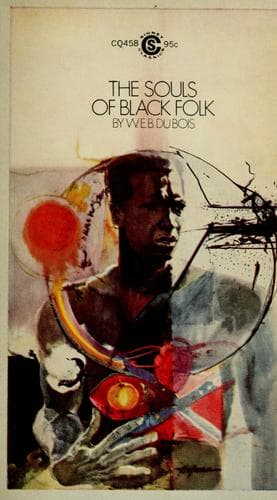
The Souls of Black FolkDu Bois, W. E. B. (William Edward Burghardt)
History
The Souls of Black Folk
Du Bois, W. E. B. (William Edward Burghardt)
African Americans
Such contributions, together with the buying of land and various other
enterprises, showed that the ex-slave was handling some free capital
already. The chief initial source of this was labor in the army, and
his pay and bounty as a soldier. Payments to Negro soldiers were at
first complicated by the ignorance of the recipients, and the fact that
the quotas of colored regiments from Northern States were largely
filled by recruits from the South, unknown to their fellow soldiers.
Consequently, payments were accompanied by such frauds that Congress,
by joint resolution in 1867, put the whole matter in the hands of the
Freedmen’s Bureau. In two years six million dollars was thus
distributed to five thousand claimants, and in the end the sum exceeded
eight million dollars. Even in this system fraud was frequent; but
still the work put needed capital in the hands of practical paupers,
and some, at least, was well spent.
The most perplexing and least successful part of the Bureau’s work lay
in the exercise of its judicial functions. The regular Bureau court
consisted of one representative of the employer, one of the Negro, and
one of the Bureau. If the Bureau could have maintained a perfectly
judicial attitude, this arrangement would have been ideal, and must in
time have gained confidence; but the nature of its other activities and
the character of its _personnel_ prejudiced the Bureau in favor of the
black litigants, and led without doubt to much injustice and annoyance.
On the other hand, to leave the Negro in the hands of Southern courts
was impossible. In a distracted land where slavery had hardly fallen,
to keep the strong from wanton abuse of the weak, and the weak from
gloating insolently over the half-shorn strength of the strong, was a
thankless, hopeless task. The former masters of the land were
peremptorily ordered about, seized, and imprisoned, and punished over
and again, with scant courtesy from army officers. The former slaves
were intimidated, beaten, raped, and butchered by angry and revengeful
men. Bureau courts tended to become centres simply for punishing
whites, while the regular civil courts tended to become solely
institutions for perpetuating the slavery of blacks. Almost every law
and method ingenuity could devise was employed by the legislatures to
reduce the Negroes to serfdom,—to make them the slaves of the State, if
not of individual owners; while the Bureau officials too often were
found striving to put the “bottom rail on top,” and gave the freedmen a
power and independence which they could not yet use. It is all well
enough for us of another generation to wax wise with advice to those
who bore the burden in the heat of the day. It is full easy now to see
that the man who lost home, fortune, and family at a stroke, and saw
his land ruled by “mules and niggers,” was really benefited by the
passing of slavery. It is not difficult now to say to the young
freedman, cheated and cuffed about who has seen his father’s head
Public-domain text, read in full here on John Shaqi.
Reviews
Reviews
No reviews yet
Be the first to share your thoughts on this work.
Join the Discussion
Join the discussion
Sign in to leave a comment or review.
Sign InorCreate an account