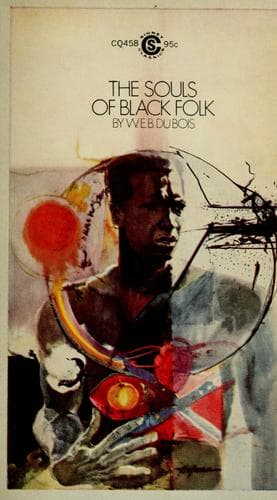
The Souls of Black FolkDu Bois, W. E. B. (William Edward Burghardt)
History
The Souls of Black Folk
Du Bois, W. E. B. (William Edward Burghardt)
African Americans
Next to this achievement comes Mr. Washington’s work in gaining place
and consideration in the North. Others less shrewd and tactful had
formerly essayed to sit on these two stools and had fallen between
them; but as Mr. Washington knew the heart of the South from birth and
training, so by singular insight he intuitively grasped the spirit of
the age which was dominating the North. And so thoroughly did he learn
the speech and thought of triumphant commercialism, and the ideals of
material prosperity, that the picture of a lone black boy poring over a
French grammar amid the weeds and dirt of a neglected home soon seemed
to him the acme of absurdities. One wonders what Socrates and St.
Francis of Assisi would say to this.
And yet this very singleness of vision and thorough oneness with his
age is a mark of the successful man. It is as though Nature must needs
make men narrow in order to give them force. So Mr. Washington’s cult
has gained unquestioning followers, his work has wonderfully prospered,
his friends are legion, and his enemies are confounded. To-day he
stands as the one recognized spokesman of his ten million fellows, and
one of the most notable figures in a nation of seventy millions. One
hesitates, therefore, to criticise a life which, beginning with so
little, has done so much. And yet the time is come when one may speak
in all sincerity and utter courtesy of the mistakes and shortcomings of
Mr. Washington’s career, as well as of his triumphs, without being
thought captious or envious, and without forgetting that it is easier
to do ill than well in the world.
The criticism that has hitherto met Mr. Washington has not always been
of this broad character. In the South especially has he had to walk
warily to avoid the harshest judgments,—and naturally so, for he is
dealing with the one subject of deepest sensitiveness to that section.
Twice—once when at the Chicago celebration of the Spanish-American War
he alluded to the color-prejudice that is “eating away the vitals of
the South,” and once when he dined with President Roosevelt—has the
resulting Southern criticism been violent enough to threaten seriously
his popularity. In the North the feeling has several times forced
itself into words, that Mr. Washington’s counsels of submission
overlooked certain elements of true manhood, and that his educational
programme was unnecessarily narrow. Usually, however, such criticism
has not found open expression, although, too, the spiritual sons of the
Abolitionists have not been prepared to acknowledge that the schools
founded before Tuskegee, by men of broad ideals and self-sacrificing
spirit, were wholly failures or worthy of ridicule. While, then,
criticism has not failed to follow Mr. Washington, yet the prevailing
public opinion of the land has been but too willing to deliver the
solution of a wearisome problem into his hands, and say, “If that is
all you and your race ask, take it.”
Public-domain text, read in full here on John Shaqi.
Reviews
Reviews
No reviews yet
Be the first to share your thoughts on this work.
Join the Discussion
Join the discussion
Sign in to leave a comment or review.
Sign InorCreate an account