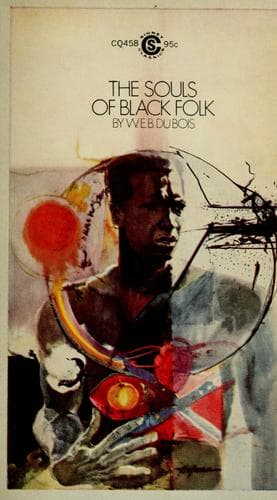
The Souls of Black FolkDu Bois, W. E. B. (William Edward Burghardt)
History
The Souls of Black Folk
Du Bois, W. E. B. (William Edward Burghardt)
African Americans
Walker’s wild appeal against the trend of the times showed how the
world was changing after the coming of the cotton-gin. By 1830 slavery
seemed hopelessly fastened on the South, and the slaves thoroughly
cowed into submission. The free Negroes of the North, inspired by the
mulatto immigrants from the West Indies, began to change the basis of
their demands; they recognized the slavery of slaves, but insisted that
they themselves were freemen, and sought assimilation and amalgamation
with the nation on the same terms with other men. Thus, Forten and
Purvis of Philadelphia, Shad of Wilmington, Du Bois of New Haven,
Barbadoes of Boston, and others, strove singly and together as men,
they said, not as slaves; as “people of color,” not as “Negroes.” The
trend of the times, however, refused them recognition save in
individual and exceptional cases, considered them as one with all the
despised blacks, and they soon found themselves striving to keep even
the rights they formerly had of voting and working and moving as
freemen. Schemes of migration and colonization arose among them; but
these they refused to entertain, and they eventually turned to the
Abolition movement as a final refuge.
Here, led by Remond, Nell, Wells-Brown, and Douglass, a new period of
self-assertion and self-development dawned. To be sure, ultimate
freedom and assimilation was the ideal before the leaders, but the
assertion of the manhood rights of the Negro by himself was the main
reliance, and John Brown’s raid was the extreme of its logic. After the
war and emancipation, the great form of Frederick Douglass, the
greatest of American Negro leaders, still led the host. Self-assertion,
especially in political lines, was the main programme, and behind
Douglass came Elliot, Bruce, and Langston, and the Reconstruction
politicians, and, less conspicuous but of greater social significance,
Alexander Crummell and Bishop Daniel Payne.
Public-domain text, read in full here on John Shaqi.
Reviews
Reviews
No reviews yet
Be the first to share your thoughts on this work.
Join the Discussion
Join the discussion
Sign in to leave a comment or review.
Sign InorCreate an account