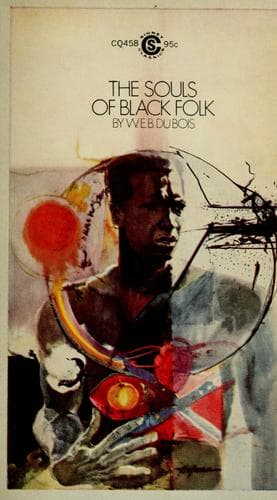
The Souls of Black FolkDu Bois, W. E. B. (William Edward Burghardt)
History
The Souls of Black Folk
Du Bois, W. E. B. (William Edward Burghardt)
African Americans
Then came the Revolution of 1876, the suppression of the Negro votes,
the changing and shifting of ideals, and the seeking of new lights in
the great night. Douglass, in his old age, still bravely stood for the
ideals of his early manhood,—ultimate assimilation _through_
self-assertion, and on no other terms. For a time Price arose as a new
leader, destined, it seemed, not to give up, but to re-state the old
ideals in a form less repugnant to the white South. But he passed away
in his prime. Then came the new leader. Nearly all the former ones had
become leaders by the silent suffrage of their fellows, had sought to
lead their own people alone, and were usually, save Douglass, little
known outside their race. But Booker T. Washington arose as essentially
the leader not of one race but of two,—a compromiser between the South,
the North, and the Negro. Naturally the Negroes resented, at first
bitterly, signs of compromise which surrendered their civil and
political rights, even though this was to be exchanged for larger
chances of economic development. The rich and dominating North,
however, was not only weary of the race problem, but was investing
largely in Southern enterprises, and welcomed any method of peaceful
cooperation. Thus, by national opinion, the Negroes began to recognize
Mr. Washington’s leadership; and the voice of criticism was hushed.
Mr. Washington represents in Negro thought the old attitude of
adjustment and submission; but adjustment at such a peculiar time as to
make his programme unique. This is an age of unusual economic
development, and Mr. Washington’s programme naturally takes an economic
cast, becoming a gospel of Work and Money to such an extent as
apparently almost completely to overshadow the higher aims of life.
Moreover, this is an age when the more advanced races are coming in
closer contact with the less developed races, and the race-feeling is
therefore intensified; and Mr. Washington’s programme practically
accepts the alleged inferiority of the Negro races. Again, in our own
land, the reaction from the sentiment of war time has given impetus to
race-prejudice against Negroes, and Mr. Washington withdraws many of
the high demands of Negroes as men and American citizens. In other
periods of intensified prejudice all the Negro’s tendency to
self-assertion has been called forth; at this period a policy of
submission is advocated. In the history of nearly all other races and
peoples the doctrine preached at such crises has been that manly
self-respect is worth more than lands and houses, and that a people who
voluntarily surrender such respect, or cease striving for it, are not
worth civilizing.
In answer to this, it has been claimed that the Negro can survive only
through submission. Mr. Washington distinctly asks that black people
give up, at least for the present, three things,—
First, political power,
Second, insistence on civil rights,
Public-domain text, read in full here on John Shaqi.
Reviews
Reviews
No reviews yet
Be the first to share your thoughts on this work.
Join the Discussion
Join the discussion
Sign in to leave a comment or review.
Sign InorCreate an account