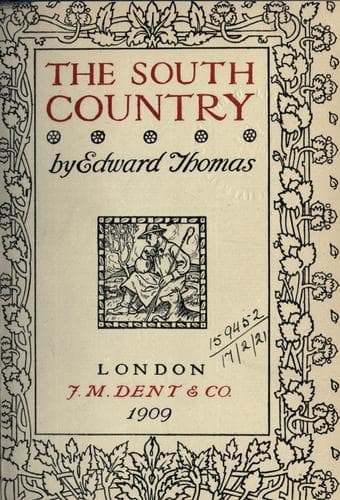
England -- Description and travel; Natural history -- England; Thomas, Edward, 1878-1917 -- Travel -- England
With the crescent goes the road, half-way up the sides of the hills but
nearly always at the foot of the steepest slopes where the chalk-pits
are carved white, like the concave of a scallop shell, out of the green
turf. Luxuriant hedges bar the view except at gateways and stiles. At
one place the upper hedge gives way to scattered thickets scrambling up
the hill, with chalky ruts and rabbit workings between. Neither sheep
nor crops cover the hill, nor yet is it common. Any one can possess
it--for an hour. It is given up to the rabbits until Londoners can be
persuaded to build houses on it. At intervals a road as old as the Way
itself descends precipitously in a deep chalk groove, overhung by yew
and beech, or hornbeam, or oak, and white clouds drifting in a river
of blue sky between the trees; and joins farther south the main road
which winds, parallel with the Pilgrims’ Way and usually south of it,
from Winchester, through Guildford, Dorking, Westerham, Maidstone,
Ashford, and Canterbury to Dover Strait. Not only chalk-pits and deep
roads hollow the hills. For miles there is a succession of small
smooth coombes, some grown with white thorn, some grassy, above the
road, alternating with corresponding smooth breasts of turf. Towers
and spires, but chiefly towers, lie beneath, and in the mile or so
between one and the next there are red farms or, very rarely, a greater
house at the end of a long wave of grass among trees. Above, the white
full-bosomed clouds lean upon the green rampart of the hills and look
across to the orchards, the woods beyond, the oaken Weald and its
lesser ridges still farther, and then the South Downs and a dream of
the south sea.
Public-domain text, read in full here on John Shaqi.
Reviews
Reviews
No reviews yet
Be the first to share your thoughts on this work.
Join the Discussion
Join the discussion
Sign in to leave a comment or review.
Sign InorCreate an account