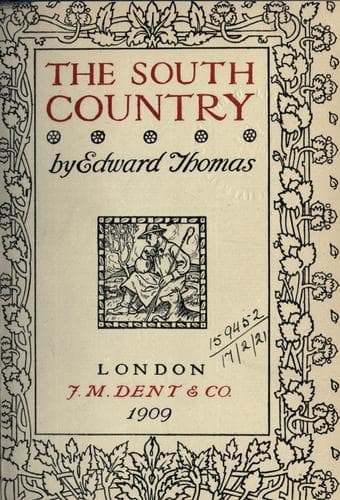
England -- Description and travel; Natural history -- England; Thomas, Edward, 1878-1917 -- Travel -- England
A little beyond is a larger bay of the same kind, bordered by a long
curving road entirely lined by elms dividing it from the broad meadow
that has an elm rookery in a corner under the steep clean slope of
down; at the end is a church singing to itself with all its bells in
the solitude. And the hedges are full of strong young thrushes which
there is no one to frighten--is there any prettier dress than the
speckled feathers of their breasts and the cape of brown over their
shoulders and backs, as they stir the dew in May?
Then the valley opens wide and the river doubles in gleaming azure
about a narrow spit of grass, in sight of a sharp white fall of chalk,
into the lucid quiet sea. At this bend a company of sycamores girds
and is one with a group of tiled and thatched and gabled buildings,
of ochre, brown and rose. The road crosses the river and a path leads
near the sea, between mustard flower, lucerne, beans, corn and grass,
in flint-walled fields, to a church and farm of flint, overtopped by
embowering chestnuts, ilex and the elms of rooks; and below there
is another valley and river, a green pathless marsh, at whose edge
five noisy belching chimneys stand out of a white pit. The path, over
turf, rises to the Downs, passing a lonely flint barn with rich dark
roof and a few sycamores for mates. This is the cornland, and the
corn bunting sings solitary and monotonous, and the linnets twitter
still in flocks. Above and around, the furzy coombes are the home of
blackbirds that have a wilder song in this world of infinite corn
below and grass above, and but one house. Violets and purple orchis
(and its white buds) cloud the turf. On the other side the Downs sink
to gently clustered and mounded woods and yet more corn surrounding a
thatched flint barn, a granary and cart-lodge, and, again, a farm under
sycamores.
The soft-ribbed grey sky of after-sunset is slowly moving, kindly and
promising rain. The air is still, the road dusty, but the hedges tender
green, and the grasshopper lark sings under the wild parsley of the
roadside and the sedge-warbler in the sallows.
Just beyond is the town by the beautiful domed hill, a town of steep
lanes and wallflowers on old walls and such a date as 1577 modestly
inscribed on a doorway; its long old street, sternly adapted to the
needs of shopkeepers and gentry, looks only old-fashioned, its age
being as much repressed as if it were a kind of sin or originality.
This is that spirit which would quarrel with the stars for not being
in straight lines like print, the spirit of one who, having been
disturbed while shaving by the sight of a favourite cat in the midst
of her lovers and behaving after the manner of her kind, gives orders
during the long mid-day meal that she shall be drowned forthwith,
or--no--to-morrow, which is Monday. This is that spirit which says--
Public-domain text, read in full here on John Shaqi.
Reviews
Reviews
No reviews yet
Be the first to share your thoughts on this work.
Join the Discussion
Join the discussion
Sign in to leave a comment or review.
Sign InorCreate an account