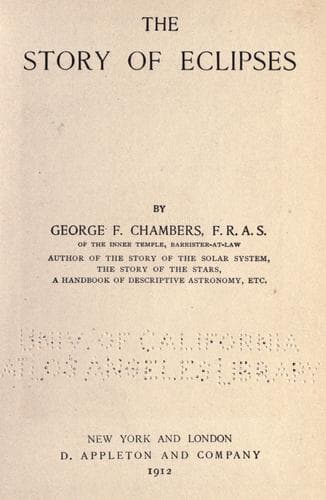
The Story of EclipsesChambers, George F. (George Frederick)
History
The Story of Eclipses
Chambers, George F. (George Frederick)
Eclipses
curving and interlacing, may tell the whole story of the Sun’s radiant
energy.”
FOOTNOTES:
[Footnote 16: There seems sufficient evidence to show that the
Corona may be seen even on occasions when the Sun is not totally
eclipsed, provided that the visible crescent of the Sun is
exceedingly narrow.]
[Footnote 17: See p. 130 (_post_).]
CHAPTER VII.
WHAT IS OBSERVED AFTER THE TOTAL PHASE
OF AN ECLIPSE OF THE SUN IS AT AN END.
In a certain sense, a description of the incidents which precede the
total disappearance of the Sun in connection with a total Eclipse will
apply more or less to the second half of the phenomenon; only, of
course, in the reverse order and on the opposite side of the compass.
The Corona having appeared first of all on the W. side of the Sun, then
having shown itself complete as surrounding the Sun, will begin to
disappear on the W. side, and will be last seen on the E. side. Baily’s
Beads may or may not come into view; the Sun will reappear first as a
very thin crescent, gradually widening; the quasi-nocturnal darkness
visible on the Earth will cease, and eventually the Moon will completely
pass away from off the Sun, and the Sun once again will exhibit a
perfect circle of light.
Whilst there is so much to look for and look at and think about, one
thing must be sought for instantly after totality, or it will be gone
for ever, and that is the Moon’s shadow on the Earth. We have already
seen in the last chapter the startling rapidity and solemnity with
which the shadow seems to rush forward to the observer from the horizon
on the western side of the Meridian. Passing over him, or even, so to
speak, through him, it travels onwards in an easterly direction and very
soon vanishes. Its visibility at all depends a good deal upon whether
the observer, who is looking for it, is sufficiently raised above the
adjacent country to be able to command at least a mile or two of ground.
If he is in a hollow, he will have but little chance of seeing the
shadow at all: on the other hand, if he is on the top of a considerable
hill (or high up on the side of a hill), commanding the horizon for a
distance of 10 or 20 miles, he will have a fair chance of seeing the
shadow. Sir G. B. Airy states, in 1851, “My eye was caught by a
duskiness in the S.E., and I immediately perceived that it was the
Eclipse-shadow in the air, travelling away in the direction of the
shadow’s path. For at least six seconds, this shadow remained in sight,
far more conspicuous to the eye than I had anticipated. I was once
caught in a very violent hail and thunder-storm on the Table-land of the
County of Sutherland called the “Moin,” and I at length saw the storm
travel away over the North Sea; and this view of the receding
Eclipse-shadow, though by no means so dark, reminded me strongly of the
receding storm. In ten or twelve seconds all appearance of the shadow
had passed away.”
Public-domain text, read in full here on John Shaqi.
Reviews
Reviews
No reviews yet
Be the first to share your thoughts on this work.
Join the Discussion
Join the discussion
Sign in to leave a comment or review.
Sign InorCreate an account