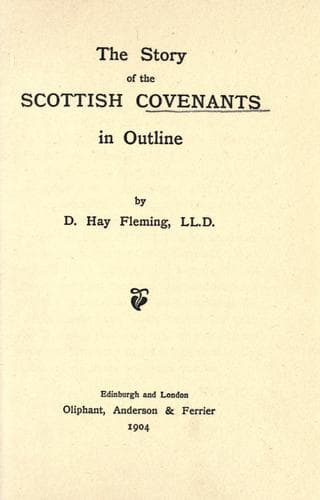
The Story of the Scottish Covenants in OutlineFleming, David Hay
History
The Story of the Scottish Covenants in Outline
Fleming, David Hay
Covenanters; Covenanters -- Scotland -- History; Covenants (Church polity); Scotland -- Church history
On the 26th of December 1647, when the King was in Carisbrooke Castle,
in the Isle of Wight, he entered into an agreement in presence of three
Scottish Commissioners—Loudoun, Lauderdale, and Lanark—in which he
intimated his willingness to confirm the Solemn League and Covenant, by
Act of Parliament in both kingdoms, provided that no one who was
unwilling to take it should be constrained to do so; he was also to
confirm by Act of Parliament in England, for three years, presbyterial
government and the Westminster Assembly’s Directory for Worship,
provided that he and his household should not be hindered from using the
service he had formerly practised; and further, an effectual course was
to be taken by Parliament and otherwise for suppressing the opinions and
practices of Anti-Trinitarians, Anabaptists, Antinomians, Arminians,
Familists, Brownists, Separatists, Independents, Libertines, and
Seekers.
On the other hand, Scotland was, in a peaceable way, to endeavour that
the King should be allowed to go to London in safety, honour, and
freedom, there to treat personally with the English Parliament and the
Scottish Commissioners; and should this not be granted, Scotland was to
emit certain declarations, and send an army into England for the
preservation and establishment of religion, for the defence of his
Majesty’s person and authority, for his restoration to power, and for
settling a lasting peace.
This agreement was known as “The Engagement”; and the same name was
applied to the expedition which, in furtherance of its object, the Duke
of Hamilton led into England, only to be crushed by Cromwell at Preston
in August 1648.
[Sidenote: Charles II. proclaimed King]
The Scottish Commissioners in London did what they could to prevent the
execution of Charles the First, and on the 5th of February 1649—six days
after the scene in front of Whitehall—the Parliament of Scotland caused
his son to be proclaimed at the Market Cross of Edinburgh, as King of
Great Britain, France, and Ireland. The Scots were determined that he
should be their King, but they were as determined that he should not
override either the General Assembly or the Parliament.
He did not like their conditions, and the first negotiations were
abortive.
Montrose organised another expedition, which collapsed at Carbisdale on
the 27th of April 1650; and on the 21st of May the gallant Marquis was
ignominiously hanged at the Market Cross of Edinburgh, and his
dismembered body buried among malefactors in the Burgh Muir.
[Sidenote: King and Covenants]
Public-domain text, read in full here on John Shaqi.
Reviews
Reviews
No reviews yet
Be the first to share your thoughts on this work.
Join the Discussion
Join the discussion
Sign in to leave a comment or review.
Sign InorCreate an account