The Story of the Scottish Covenants in Outline — John Shaqi
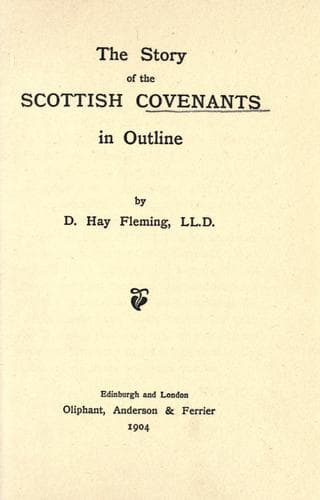
The Story of the Scottish Covenants in OutlineFleming, David Hay
History
The Story of the Scottish Covenants in Outline
Fleming, David Hay
Covenanters; Covenanters -- Scotland -- History; Covenants (Church polity); Scotland -- Church history
The Prince had “already endeavoured to procure assistance from the
Emperour, and the Electours, Princes, and States of the Empire, from the
Kings of Spaine, France, and Denmarke, and most of the Princes and
States of Italy,” and had only obtained “dilatory and generall
answeres.” All his friends, he said, advised him “to make an agreement
upon any termes with our subjects of Scotland”; and he took their advice
as the only means of obtaining this crown and recovering his other
kingdoms. He offered to subscribe and swear the National Covenant, and
the Solemn League and Covenant, before landing at the mouth of the Spey,
and he accordingly did so on the 23rd of June 1650.
On the 16th of August he agreed to the Dunfermline Declaration,
deploring his father’s opposition to the work of reformation, confessing
his mother’s idolatry, professing his own sincerity, declaring that “he
will have no enemies but the enemies of the Covenant, and that he will
have no friends but the friends of the Covenant,” and expressing his
detestation of “all Popery, superstition, and idolatry, together with
Prelacy, and all errors, heresie, schism and profaneness,” which he was
resolved not to tolerate in any part of his dominions.
[Sidenote: Dunbar and Scone]
Notwithstanding Cromwell’s notable victory at Dunbar on the 3rd of
September, and the dissatisfaction of the more rigid Covenanters, now
known as Remonstrants, Charles was crowned at Scone on the 1st of
January 1651, when he again swore and subscribed the National Covenant,
and also the Solemn League and Covenant. The Marquis of Argyll placed
the crown on his head, and Robert Douglas preached the sermon. The
attempt to counteract Cromwell’s power in Scotland by an invasion of
England was unsuccessful. The Committee of the Scottish Estates was
captured at Alyth before the end of August; and Cromwell obtained his
“crowning mercy” at Worcester on the 3rd of September. The young King,
after many adventures and narrow escapes, was glad to find himself again
on the Continent.
[Sidenote: Resolutioners and Protesters]
In December 1650, after obtaining the opinion of the Commissioners of
the General Assembly, the Scottish Parliament had “admitted manie, who
were formerlie excluded, to be imployed in the armie”; and in June 1651
had rescinded the Acts of Classes, by which certain classes of
delinquents had been shut out of places of public trust. Those who were
in favour of admitting these men were known as Resolutioners; and their
opponents, as Protesters. This unfortunate dispute split the
Presbyterians into two sections, and their contentions had not come to
an end when the Restoration of Charles was effected in 1660.
[Sidenote: The Restoration]
Public-domain text, read in full here on John Shaqi.
Reviews
Reviews
No reviews yet
Be the first to share your thoughts on this work.
Join the Discussion
Join the discussion
Sign in to leave a comment or review.
Sign InorCreate an account