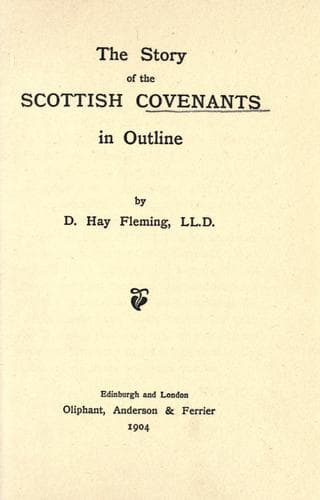
The Story of the Scottish Covenants in OutlineFleming, David Hay
History
The Story of the Scottish Covenants in Outline
Fleming, David Hay
Covenanters; Covenanters -- Scotland -- History; Covenants (Church polity); Scotland -- Church history
That Restoration was mainly brought about by General Monk. When it was
seen to be inevitable, the leading Resolutioners sent James Sharp,
minister of Crail, to London, to look after the interests of the
Scottish Church. He was diplomatic and astute, and, in the opinion of
his brethren, honest and trustworthy. His letters, bristling with
devotional expressions, “seem,” as Hugh Miller puts it, “as if strewed
over with the fragments of broken doxologies.” After it was too late,
they found that he had betrayed his trust, and completely hoodwinked
them.
[Sidenote: The King’s Honour]
The General Assembly had been suppressed under Cromwell’s iron rule, and
the Church of Scotland was otherwise handicapped at this period; but
something effective might have been done to safeguard her rights had the
Resolutioners not been deceived by Sharp, although it would have been
impossible to make Charles the Second safe, either by the renewal of
former or by additional obligations, even if the Scots had been able to
impose these upon him. Such a man could not be tied by oaths. At his
Restoration, those in power trusted to his honour, and of that virtue he
had wondrously little.
His entry into London had been timed to take place on the 29th of May
1660—the thirtieth anniversary of his birthday. Some of the leading
Protesters, fearing the overthrow of Presbytery, met in Edinburgh, on
the 23rd of August, to draw up a supplication to the King. The Committee
of Estates arrested them, and imprisoned them in the castle.
[Sidenote: The Act Rescissory]
A few days afterwards Sharp brought a letter from his Majesty, in which
he said: “We do also resolve to protect and preserve the government of
the Church of Scotland, _as it is settled by law_, without violation.” A
suggestion that this might be understood in two ways, was condemned as
“an intolerable reflection” on the King. The Scottish Parliament, on the
28th of March 1661, rescinded the Parliaments which had been held in and
since 1640, and all the Acts passed by them. Thus all the civil sanction
which had been given to the Second Reformation was swept away at a
stroke. Early next morning, Samuel Rutherfurd—whose stipend had been
confiscated, whose “Lex Rex” had been burned, and who had been cited to
answer a charge of treason—appeared before a court that was higher than
any Parliament, and “where his Judge was his friend.”
A month after this, Sharp professed, in a letter to James Wood, that he
was still hopeful that there would, “through the goodnes of God,” be no
change; and affirmed that, as he had, “through the Lord’s mercy,” done
nothing to the prejudice of the liberties and government of the Church,
so he would not, “by the grace of God,” have any accession to the
wronging of it.
[Sidenote: Duplicity]
Public-domain text, read in full here on John Shaqi.
Reviews
Reviews
No reviews yet
Be the first to share your thoughts on this work.
Join the Discussion
Join the discussion
Sign in to leave a comment or review.
Sign InorCreate an account