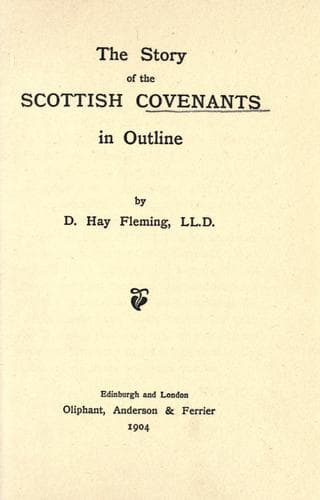
The Story of the Scottish Covenants in OutlineFleming, David Hay
History
The Story of the Scottish Covenants in Outline
Fleming, David Hay
Covenanters; Covenanters -- Scotland -- History; Covenants (Church polity); Scotland -- Church history
He was then on the eve of setting out for London with Glencairn and
Rothes. They returned in the end of August, bringing with them a letter
intimating the King’s determination to interpose his royal authority for
restoring the Church of Scotland “to its right government by bishops as
it was by law before the late troubles”; and justifying his action by
his promise of the previous year. Candid Episcopalians admit that this
dealing shook all confidence in the sincerity of Charles.
[Sidenote: Episcopacy Re-established]
In October Sharp again went to England; in November he was appointed
Archbishop of St Andrews; and in December he was consecrated in
Westminster Abbey, after being privately ordained as a deacon and a
priest. The Scottish Parliament, on the 27th of May 1662, passed the
“Act for the restitution and re-establishment of the antient government
of the church by archbishops and bishops.” The preamble of this Act
acknowledges that “the ordering and disposall of the externall
government and policie of the Church doth propperlie belong unto his
Majestie, as are inherent right of the Croun, by vertew of his royall
prerogative and supremacie in causes ecclesiasticall.” The Oath of
Allegiance, which had been adopted by Parliament on the 1st of January
1661, contained the clause: “I acknowledge my said Soverane only supream
governour of this kingdome over all persons and in all causes.”
[Sidenote: Argyll and Guthrie]
The Solemn League and Covenant had already been burned by the hangman in
London; and the long and bloody persecution in Scotland had already
begun. An example had been made of the Marquis of Argyll, and of James
Guthrie, the minister of Stirling. Both suffered at the Market Cross of
Edinburgh in the same week, Argyll on Monday, the 27th of May, and
Guthrie on Saturday, the 1st of June, 1661. To secure Argyll’s
conviction, Monk was base enough to give up several of his letters
proving his hearty compliance with the Usurper’s government after it was
established. The case for the prosecution was closed before the letters
arrived; but they were nevertheless received and read.
Sir George Mackenzie—later to acquire an unenviable notoriety as the
Bluidy Mackenyie—was one of his advocates, and in his opinion the
Marquis suffered mainly for the good old cause. Guthrie had never
compromised himself in any way with Cromwell, who described him as the
little man who would not bow.
[Sidenote: Ministers Disqualified]
Public-domain text, read in full here on John Shaqi.
Reviews
Reviews
No reviews yet
Be the first to share your thoughts on this work.
Join the Discussion
Join the discussion
Sign in to leave a comment or review.
Sign InorCreate an account