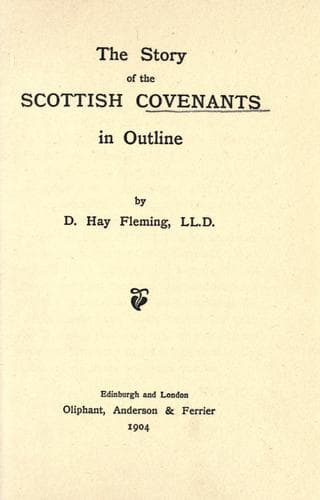
The Story of the Scottish Covenants in OutlineFleming, David Hay
History
The Story of the Scottish Covenants in Outline
Fleming, David Hay
Covenanters; Covenanters -- Scotland -- History; Covenants (Church polity); Scotland -- Church history
Early in 1664 the King resolved to re-erect, by virtue of his royal
prerogative, the Court of High Commission, to enforce the Acts “for the
peace and order of the Church, and in behalf of the government thereof
by archbishops and bishops.” The extraordinary power vested in this
court was increased in range by the general clause, authorising the
Commissioners “to do and execute what they shall find necessary and
convenient for his Majesty’s service in the premises.” Any five of the
Commissioners could act, if one of them were an archbishop or bishop. No
provision was made for any appeal from the judgment of this court. Of it
a learned member of the bar has said: “All law and order were
disregarded. The Lord Advocate ceased to act as public prosecutor, and
became a member of this iniquitous tribunal. No indictments were
required; no defences were allowed; no witnesses were necessary. The
accused were dragged before the Commissioners, and compelled to answer
any questions which were put to them, without being told of what they
were suspected.” The court could order ministers “to be censured with
suspension or deposition”; and could punish them and others “by fining,
confining, committing to prison and incarcerating.” For nearly two years
this court harassed and oppressed the Nonconformists of Scotland.
[Sidenote: Origin of Pentland Rising]
Towards the close of 1665, conventicles were, by royal proclamation,
forbidden under severe penalties. The officiating ministers, and those
harbouring them, were threatened with the highest pains due to sedition,
and hearers were subject to fining, confining, and other corporal
punishments.
Such measures could hardly be expected to beget in the people an ardent
love for Prelacy; and when opposition was manifested in the south-west
of Scotland, troops, under Sir James Turner, were sent to suppress it.
[Sidenote: Torture and Execution]
At length the harshness of a handful of soldiers to an old man, at Dalry
in Galloway, led to a scuffle with a few countrymen, and the success of
the latter led to the untimely rising which was suppressed by General
Dalyell at Rullion Green on the 28th of November 1666. In that
engagement the slain and mortally wounded Covenanters numbered over
forty. On the 7th of December ten prisoners—all of whom, save one, had
been promised quarter—were hanged at the Market Cross of Edinburgh. In
less than a month, fully twenty more prisoners had been hanged at
Edinburgh, Glasgow, Irvine, Ayr, and Dumfries. Two of these—Neilson of
Corsack and Hugh M’Kail—were tortured in the boots. Never before had
drums been used in Scotland to drown the voice of a victim dying on the
scaffold. At this time it was introduced at Glasgow.
Public-domain text, read in full here on John Shaqi.
Reviews
Reviews
No reviews yet
Be the first to share your thoughts on this work.
Join the Discussion
Join the discussion
Sign in to leave a comment or review.
Sign InorCreate an account