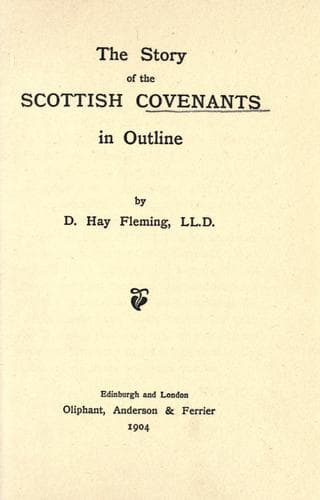
The Story of the Scottish Covenants in OutlineFleming, David Hay
History
The Story of the Scottish Covenants in Outline
Fleming, David Hay
Covenanters; Covenanters -- Scotland -- History; Covenants (Church polity); Scotland -- Church history
Had the rising not been so ill-timed, it would probably have been much
better supported. After its suppression, Rothes and Dalyell wrote
gloomily of the condition of Ayrshire; but Dalyell was not the man to
shrink from quelling incipient rebellion by force. Compared with his
measures, those of Sir James Turner were mild, although they had driven
the sufferers to despair. Finding that his own influence was in peril
through the alliance between the military and ecclesiastical party,
Lauderdale broke up this brutal administration.
[Sidenote: The Indulgence]
The first indulgence (granted in the summer of 1669) was fated, as its
successors were, to be a bone of contention among the Covenanters. It
was condemned by the more scrupulous because of its restrictions; and
because, as they held, compliance with it involved the owning of the
royal supremacy in ecclesiastical matters. Many refused to hear the
indulged ministers, and some would have nothing to do with those
non-indulged ministers who did not denounce the indulgence. It was also
disliked and resented by Alexander Burnet, Archbishop of Glasgow, and
his diocesan synod, but for very different reasons. They objected to
indulged Presbyterian ministers being exempted from Episcopal
jurisdiction, and objected all the more because, in some districts, the
people would not countenance either doctrine or discipline under
Episcopal administration.
[Sidenote: Conventicles]
The ejection of the ministers, and the filling of their places by the
miserable substitutes then termed “curates,” had led to the keeping of
conventicles, and as the indulgence, like the proclamation of 1665,
failed to put an end to these unauthorised religious services, it was
resolved to put them down with a strong hand. Parliament decreed, in
1670, that non-indulged, outed ministers, or other persons not allowed
by the bishops, who either preached or prayed in any meeting, “except in
ther oune housses and to those of ther oune family,” should be deemed
guilty of keeping conventicles, and should be imprisoned until they
found caution not to do the like again, or bound themselves to leave the
kingdom; and those who conducted, or convocated people to,
field-conventicles, were to be punished by death and confiscation of
their goods, and hearers were to be severely fined. The Act explained
that a house-conventicle became a field-conventicle if there were more
persons present than the house contained, so that some of them were
outside the door.
Public-domain text, read in full here on John Shaqi.
Reviews
Reviews
No reviews yet
Be the first to share your thoughts on this work.
Join the Discussion
Join the discussion
Sign in to leave a comment or review.
Sign InorCreate an account