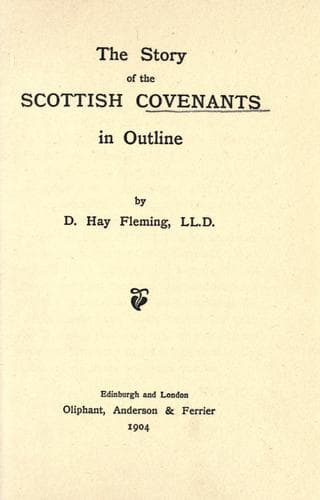
The Story of the Scottish Covenants in OutlineFleming, David Hay
History
The Story of the Scottish Covenants in Outline
Fleming, David Hay
Covenanters; Covenanters -- Scotland -- History; Covenants (Church polity); Scotland -- Church history
The enormities of the French in Scotland were so great, that Mary of
Guise, in writing to her brothers, affirmed that the peasantry were in
consequence so reduced to despair that they frequently committed
suicide. Although these unbridled excesses are enough to explain the
revulsion of feeling towards the French, they do not quite account for
the sudden alteration towards the English. The change, indeed, was so
sudden and so unlikely that some Southerns thought, and naturally
thought, it was “a traine to betrappe” their nation.
[Sidenote: Scots and English]
So great had been the Scotch hatred of the English, that, from the
French who came over to help them after Pinkie, they were said to have
bought English prisoners, that they might have the pleasure of putting
them to death, although they could ill afford the price which they paid
ungrudgingly. This hatred, so bitter, so fierce, and so recent, could
not have been wiped out by any French oppression had not the Scots been
now finding themselves ranged on the same side as the English in the
great religious struggle, which was submerging old feuds, breaking up
old compacts, and turning the world upside down.
[Sidenote: Band of 1560]
The oppression by the French, and the help expected from the English
army, are both referred to in the band or covenant entered into on the
27th of April 1560. Knox says that this band was made by “all the
nobilitie, barronis, and gentilmen, professing Chryst Jesus in
Scotland,” and by “dyveris utheris that joynit with us, for expelling of
the Frenche army; amangis quham the Erle of Huntlie was principall.” He
does not name any other person who signed, although he copied the band
itself into his “History”; but the original document was found among the
Hamilton MSS., and it bears about a hundred and fifty signatures of
noblemen and gentlemen, including those of the Duke of Chatelherault,
the Earls of Arran, Huntly, Argyll, Glencairn, Rothes, and Morton, James
Stewart (afterwards the Regent Murray), and the Abbots of Kinloss,
Coupar, and Kilwinning. All those who adhibited their names did not do
so on the same day. Huntly signed on the 28th of April; Morton and
twenty-seven others on the 6th of May.
[Sidenote: Treaty of Edinburgh]
Public-domain text, read in full here on John Shaqi.
Reviews
Reviews
No reviews yet
Be the first to share your thoughts on this work.
Join the Discussion
Join the discussion
Sign in to leave a comment or review.
Sign InorCreate an account