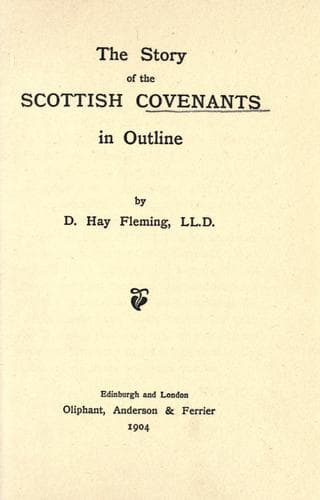
The Story of the Scottish Covenants in OutlineFleming, David Hay
History
The Story of the Scottish Covenants in Outline
Fleming, David Hay
Covenanters; Covenanters -- Scotland -- History; Covenants (Church polity); Scotland -- Church history
The French had fortified Leith, but were so hard pressed by the English
and the Scots that they were constrained to make the Treaty of
Edinburgh, with Queen Elizabeth’s representatives, on the 6th of July
1560. It was by that treaty, or rather—to be more strictly accurate—in
virtue of the concessions in the separate “accord” between the French
and the Scots of the same date, and which is referred to in the treaty,
that the Scots were able to throw off for ever the merciless tyranny of
their old allies and the unbearable yoke of the Papacy. These
concessions provided for a meeting of Parliament; and next month that
Parliament repealed the Acts favouring the Church of Rome, abolished the
Pope’s jurisdiction in Scotland, prohibited the celebration of mass
under pain of death for the third conviction, and ratified the
Confession of Faith drawn up by Knox, Wynram, Spottiswoode, Willock,
Douglas, and Row.
Mary Queen of Scots returned from France to her own country in August
1561, and a year later made her first northern progress, in which she
went as far as Inverness. Huntly, notwithstanding his having signed the
band of 1560, was regarded as the lay head of the Papists in Scotland,
and grave doubts were entertained by many of the Protestants as to the
results of this progress of the young Queen.
[Sidenote: Band of 1562]
Knox was then in Ayrshire, and, alarmed by the rumours which reached
him, he prevailed on many of the barons and gentlemen of that county to
enter into another band, or covenant, at Ayr, on the 4th of September
1562, in order to be prepared for any attempt that might be made to put
down Protestantism. It does not appear that it had any influence on the
course of events in the North, but it probably had a considerable,
though indirect, influence in restraining those in the South, who might
have been inclined to help Huntly had there been any prospect of their
being able to do so successfully. Those who took the band were not
called upon to show their faithfulness in the field. Huntly—through
perversity, stupidity, or suspicion—put himself completely out of the
Queen’s graces. His forces were defeated, he died on the field of
battle, one of his sons was executed, and another imprisoned.
[Sidenote: The Queen’s Demission]
On Thursday, the 24th of July 1567, the Queen, then a prisoner in Loch
Leven Castle, was prevailed upon (by threats, she afterwards said) to
demit the government in favour of her infant son, James, then thirteen
months old. The General Assembly had met on the preceding Monday in the
Over Tolbooth of Edinburgh; and on Friday, the 25th, the nobles, barons,
and commissioners of towns, who were present, agreed to and subscribed
certain “articles.”
[Sidenote: Articles of 1567]
Public-domain text, read in full here on John Shaqi.
Reviews
Reviews
No reviews yet
Be the first to share your thoughts on this work.
Join the Discussion
Join the discussion
Sign in to leave a comment or review.
Sign InorCreate an account