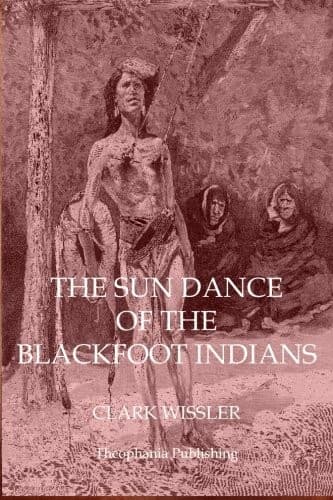
The Sun Dance of the Blackfoot IndiansWissler, Clark
Religion
The Sun Dance of the Blackfoot Indians
Wissler, Clark
Siksika Indians; Sun dance
As previously stated, the natoas ritual in the sun dance has for its
mythical basis the Elk-woman and the Woman-who-married-a-star, though
Scar-face, Cuts-wood, Otter-woman, and Scabby-round-robe are said to
have made minor contributions. Versions of these myths may be consulted
in Volume 2, part 1 of this series. The Woman-who-married-a-star is
credited with bringing down the digging-stick and the turnip, together
with the songs pertaining thereto (p. 61), also a wreath of juniper
formerly worn in place of the natoas and the eagle feather worn by the
man.
It is also interesting to note that the Crane-woman who transfers the
ritualistic attributes of these objects makes a formal declaration of
her marital virtue. In the case of Elk-woman, we have again the incident
of the Crane and the digging-stick where it is implied that the latter
symbolizes the bill of the former. We are informed that many animals
were present at this transfer, each contributing something to the
regalia. We also find it suggested that the bunches of feathers on the
natoas represent the horns of the elk, the elk robe and elk teeth
wristlets further symbolizing that animal. In one version of this myth
is the antagonistic implication that Elk-woman was not quite up to the
standard of marital virtue. In the Cuts-wood myth the "going forward to
the tongues" is accounted for. Scabby-round-robe is credited with adding
the necklace and the arrow point to the natoas and Otter-woman with the
wild cat-tail.
The following statement of an informant has a bearing upon this point:--
The natoas is said to have come from the Elk. It was first owned by
beaver bundle men, but it was the custom for the medicine woman in
the sun dance to borrow it for her ceremony. This continued for a
time, but ultimately the medicine woman bought it and kept it in a
bundle of her own. The feathers on the front of the natoas are said
to represent the horns of Elk and the plumes at the sides, the leafy
top of the large turnip. This is the same turnip which the woman who
went to the sky land is supposed to have dug up. The digging-stick
which accompanies the natoas also represents the stick with which
she did this digging. Some of the songs in the natoas ritual speak
of little children running about and this refers to the ball-like
image on the front of the natoas, for this image is stuffed with
tobacco seeds, which, as you know, are often spoken of as children,
or dwarfs (p. 201). The broad band upon which the natoas is mounted
is said to represent the lizard. All these things, it is said, were
added to the natoas, one at a time, by some of the beaver men. So it
came about that we have the natoas as it is.
Public-domain text, read in full here on John Shaqi.
Reviews
Reviews
No reviews yet
Be the first to share your thoughts on this work.
Join the Discussion
Join the discussion
Sign in to leave a comment or review.
Sign InorCreate an account