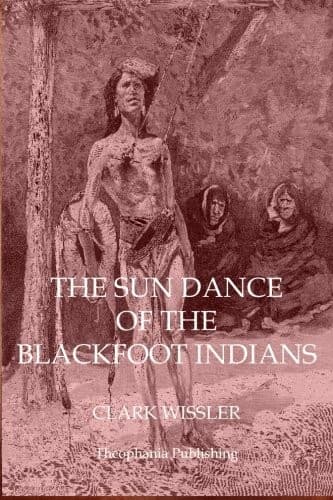
The Sun Dance of the Blackfoot IndiansWissler, Clark
Religion
The Sun Dance of the Blackfoot Indians
Wissler, Clark
Siksika Indians; Sun dance
Throughout the whole period there is a male attendant. He keeps the fire
alive during the night and until camp is moved. He can only start the
fire with an ember from some other tipi, striking fire in the tipi being
strictly prohibited. Pipes can only be lighted from the fire by this
attendant with service berry sticks. A blaze must be avoided as much as
possible. The attendant cuts the tobacco and fills the pipe and when
burnt out he must empty the ashes into a small hole in the ground near
his seat. Everyone is expected to sit quietly, leaving the moving to
him. He remains on duty during the night also.
Formerly, the tipi of the medicine woman was moved three times, four
different camps resulting, the last being at its position in the circle
for the sun dance. As a considerable journey was often necessary to
reach the sun dance site these camps might be far apart. Theoretically,
the camp is pitched late in the afternoon of each day. At the sun dance
a special sweathouse ceremony takes place. This will be discussed later.
After this the evening and greater part of the night are spent by those
in attendance at the medicine woman's tipi in rehearsing the songs and
instructing the son and daughter.
Like everything else, moving the camp of the medicine woman is a formal
matter. The travois is made, painted red, and reserved for the special
use of the medicine woman. When the time for breaking camp in the
medicine woman's band arrives, she and her husband are led out and
seated upon a robe at the west or rear of their tipi, facing in the
direction to move. The parfleche of tongues and other paraphernalia are
brought out by the attending women and put down beside the couple. The
mother directs the attending women in taking down the tipi and hitching
the horse to the travois. The parfleche of tongues is packed on the
travois. When all is ready, the woman and man are led to their horses
and assisted to mount, the woman riding the horse to the travois. The
father and the son go ahead in single file, next the mother and the
daughter, or medicine woman. They pause four times, as songs are sung.
After they get some distance out, they stop and wait for the camp, now
moving for the first time. This procession of four always leads, the two
men side by side and behind them the two women likewise. At noon, when
they stop for lunch, the two are again seated on a robe, the travois
unhooked and laid down before them. Then follows the camp some distance
behind. The old men form a circle and smoke near the pair.
At this time the father orders one of the men's societies to go forward
and mark out a camp site. When this spot is reached, tipis are pitched
and when everything is in place the medicine woman and her husband are
taken inside.
Public-domain text, read in full here on John Shaqi.
Reviews
Reviews
No reviews yet
Be the first to share your thoughts on this work.
Join the Discussion
Join the discussion
Sign in to leave a comment or review.
Sign InorCreate an account