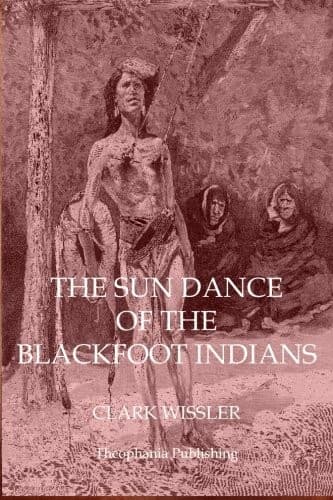
The Sun Dance of the Blackfoot IndiansWissler, Clark
Religion
The Sun Dance of the Blackfoot Indians
Wissler, Clark
Siksika Indians; Sun dance
Not long after the sun dance this same man became ill again. Finally, as
a last resort, he called upon the first wife to save him again. This
woman told him to call upon the other woman as he seemed to have so much
faith in her. So he died and was properly punished for so unjustly
treating his faithful wife.
FOOTNOTES:
[6] In former times, the natoas and the medicine woman's costume were
owned by a beaver man. When a woman gave a sun dance she gave a horse
for their use. She just borrowed them. Later on, a beaver man
transferred them, whence they became a separate bundle.--Tom Kiyo.
[7] Should the woman already own a natoas and the transferrer (father)
own one; the woman must say which bundle shall be used. She can use
her own, borrow, or purchase of the transferrer.--Curly-bear.
[8] A Piegan informant comments as follows: The woman can either buy
or borrow a natoas. In the olden times she often borrowed because the
natoas, the dress, the elk tooth wristlets, and the robe were owned by
a beaver man's wife. After a time, however, these were transferred to
a medicine woman and were thus separated from the beaver bundle.
THE PROCESSION TO THE DANCING LODGE.
In our account of the natoas ritual we told how the father, son, etc.,
emerge from their tipi. The file is headed by the father, followed by
the son, next the mother, then the medicine woman followed by women
bearing the tongues. The father and the son are muffled in blankets
(robes); the latter walks with bowed head, leaning heavily on a staff
and bearing over his head a wild rhubarb stalk.[9] The medicine woman
wears the natoas on her head, an elkskin (often buckskin) dress and an
elkskin robe, with the digging-stick on her back. For a staff, she uses
one of the smudge sticks. The women in her rear bear parfleches
containing the tongues, together with blankets and other ordinary
objects. Two or three old men act as conductors, or flankers, keeping
the way clear of spectators, etc. The procession moves slowly and by
stages. The four principal personages in it keep their eyes upon the
ground. The course is southward past the entrance (east side) to the
dancing lodge, around the south side, the rear of the shelter and
entering from the north side. Here the medicine woman remains until the
dancing lodge is raised at sunset, when she returns to her tipi and
breaks her fast with berry soup. The father and the son go to a
sweathouse after which their responsibilities also end. During the
continuance of the ceremonies in the sun lodge, the medicine woman cares
for the natoas bundle, now her property, until transferred to another,
but is otherwise free to do as she likes. She usually remains quietly at
home receiving guests and resting.
Public-domain text, read in full here on John Shaqi.
Reviews
Reviews
No reviews yet
Be the first to share your thoughts on this work.
Join the Discussion
Join the discussion
Sign in to leave a comment or review.
Sign InorCreate an account