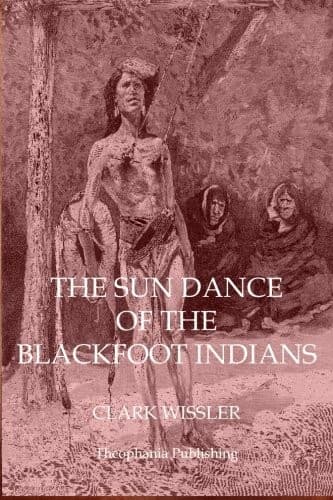
The Sun Dance of the Blackfoot IndiansWissler, Clark
Religion
The Sun Dance of the Blackfoot Indians
Wissler, Clark
Siksika Indians; Sun dance
The part of the medicine woman is truly a sacrifice. She and her husband
must pay liberally everyone called upon for ceremonial service directly
connected with the tongues and the natoas ritual. They must also pay a
considerable amount of property for the natoas itself. To give the
ceremony means the sacrifice of all personal property. On the other
hand, there is compensation, aside from fulfilling the vow. Her
relatives are very proud of her since she is so virtuous. She is highly
respected by her husband and family. In a measure those who "take the
tongues" are also respected. The medicine woman may act as the mother in
a future sun dance for which she will receive presents and she may
eventually realize something by transferring the natoas to another.
Should anything go wrong during the ceremony, the weather be
unfavorable, etc., people will look with suspicion upon her and say she
must have lied in her confession to the sun. Should she become ill or
have deaths in the family, the same charge will be made.
_The Offerings of Cloth._ After the procession headed by the father and
he is in position at the west side of the dancing lodge, offerings of
cloth and clothing are brought up by the people. A man making such an
offering hands the father a filled pipe and the cloth. The father holds
the pipe and offers prayers for the giver and lights and passes the pipe
to other old men sitting around. The cloth he lays in a pile. Then he
paints the giver: first the face is smeared over with red, then black
spots are daubed on the cheeks, nose, forehead, and chin, four in all. A
black circle is marked around each wrist. Women bringing offerings and
pipes go to the mother who prays for them and paints their faces red
with a black spot on the nose and a black circle around the face. There
is also a black circle around each wrist.
FOOTNOTES:
[9] Scar-face is said to have made a whistle (flageolet) of such a
stalk. The pith of the growing plant is sometimes eaten for food.
THE HUNDRED-WILLOW SWEATHOUSE.
As stated before, a sweathouse of special form is constructed on the
third day. This is said to have originated with Scar-face, it being the
house into which he was taken by the sun. About the middle of the day a
society is sent out for the willows. These were usually those of the
younger men; the pigeons and mosquitoes. There is a belief, however,
that in former times only warriors could be sent upon this errand. These
persons are mounted and return in procession, singing and circling the
medicine woman's tipi in the direction of the sun, and deposit their
willows at the west side of the camp circle. They must not drink water
while on this duty.
Public-domain text, read in full here on John Shaqi.
Reviews
Reviews
No reviews yet
Be the first to share your thoughts on this work.
Join the Discussion
Join the discussion
Sign in to leave a comment or review.
Sign InorCreate an account