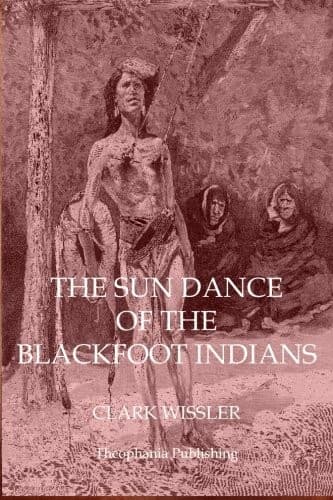
The Sun Dance of the Blackfoot Indians — John Shaqi
The Sun Dance of the Blackfoot IndiansWissler, Clark
Religion
The Sun Dance of the Blackfoot Indians
Wissler, Clark
Siksika Indians; Sun dance
The cutting of the sun pole is attended with some ceremony. Some
informants claim that formerly this was to be carried out by the
medicine woman's band; others that one of the men's societies was called
upon for this service. In any event, they go out as a war party and
locate a suitable tree. A man with a war record, preferably one having
struck an enemy with an ax, comes forward, takes an ax, paints the blade
as he recounts some event in which he killed an enemy, and then strikes
the tree. Four such deeds must be told before the tree can be felled.
Then one or two men cut the tree as the others stand around. As the tree
begins to fall all give the war cry and shoot at its top, then rush up,
and tearing off branches, wave them in the air as if they were trophies
from an enemy. Indeed, the whole proceeding, from start to finish, is a
mimic attack on an enemy.
The pole is cut to approximate form and taken to the site of the dancing
lodge. One end is placed on a travois (in recent times on a wagon),
while the riders assist with their ropes, their horses massed around the
travois horse.
The hole for the sun pole is dug without ceremony by relatives of the
medicine woman. When it is in place, they tie a bundle of green boughs
in the fork,[11] making everything ready for the raising in the evening.
The sun pole now lies on the ground with the butt over the hole and the
forked end supported by a piece of timber. The fork points to the west.
It seems that formerly the pole was painted. Just below the fork it was
circled by two black bands and two red ones beneath these.
FOOTNOTES:
[10] Obviously, this would make the dancing lodge very large. In reply
to this objection it was said that they were large; that it was
necessary to select as a site places where very long rafter poles
could be cut; that formerly societies and others performed evolutions
within on horseback. The late Little-plume is credited with having
introduced the present custom of reciting deeds, requiring horses,
outside the dancing lodge. It may be of interest to note that the
Arapaho also made very large sun dance shelters.
In 1908 Mr. Duvall measured the dancing lodge. The sun pole stood
sixteen feet from the ground to the fork. The posts were eight feet
and approximately sixteen feet apart. The diameter of the whole was
fifty-two feet. The fireplace was east of the sun pole six feet and
was four feet by two feet and five inches deep. The booth for
medicinemen was five feet eight inches wide by seven feet six inches
deep. The two holes were about a foot forward from the sod walls,
eight inches across and six inches deep. The man who has been marking
out the site for the lodge during the last few years, begins by
selecting the place for the sun pole and stepping off seven paces as
the radius.
Public-domain text, read in full here on John Shaqi.
Reviews
Reviews
No reviews yet
Be the first to share your thoughts on this work.
Join the Discussion
Join the discussion
Sign in to leave a comment or review.
Sign InorCreate an account