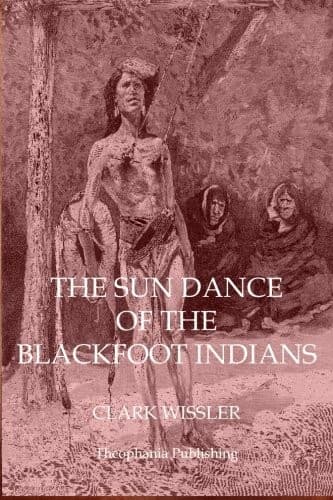
The Sun Dance of the Blackfoot IndiansWissler, Clark
Religion
The Sun Dance of the Blackfoot Indians
Wissler, Clark
Siksika Indians; Sun dance
RAISING THE SUN POLE.
While the hide is being cut, all the woman who made vows to take some of
the tongues come forward to the parfleche placed near the medicinemen
and women. Each woman takes one of the tongues and stands with the
person for whom her vow was made and makes a confession to the sun in a
loud voice, so all may hear. Then she prays to the sun for the
beneficiary. After all the women have taken their tongues, some of the
men tie the cloth offerings to the ends of the poles and a bunch of
birch is tied between the forks of the center pole.
The preceding ceremony comes to a close as the sun gets very low. About
time for the sun to set, a procession of pole raisers starts from each
of the four quarters of the camp circle. Tipi poles are tied near the
small ends in pairs, each pair carried by two men. The four parties
advance in unison by four stages and at each pause sing a special song.
In the last move, they rush upon the sun pole and raise it in place. In
the meantime, the father and son go and stand on the center pole while
their wives stand to the west. The men make wing movements with their
arms toward the east. According to some informants, the medicine woman
may make hooking motions at the pole, to symbolize the mythical
Elk-woman.
Four men are called upon to assist the father and son. As the latter
stand upon the pole, they encircle and screen them with their blankets
and join the father in singing. The songs call for good luck in erecting
the dancing lodge. The son does not sing. Four songs are sung. At the
end of each the father blows a whistle while someone shakes the pole.
The last time they jump off the pole. The son drops his blanket (some
say the father also, some add moccasins) painted black as a sun
offering. Another blanket is handed him at once.
As soon as the men leave the pole the advancing raisers rush in, raise
the center pole, put on the rafters, tie them with the rawhide strands
and place brush all around to form the wind-break. This is accompanied
by much shouting, but without shooting.
While the sun pole is being raised the daughter and mother stand
watching it. They pray and make movements with the corners of their
robes as though steering the rising pole. As it sways from side to side,
they gesture as if righting it.
As soon as the pole is set, the natoas, robe, and moccasins are taken
off the daughter by the mother. She may call on someone to do this and
pay a gun or a horse for the service. The mother and other attendants
then lead the daughter to her tipi where she resumes her ordinary
routine.
Public-domain text, read in full here on John Shaqi.
Reviews
Reviews
No reviews yet
Be the first to share your thoughts on this work.
Join the Discussion
Join the discussion
Sign in to leave a comment or review.
Sign InorCreate an account