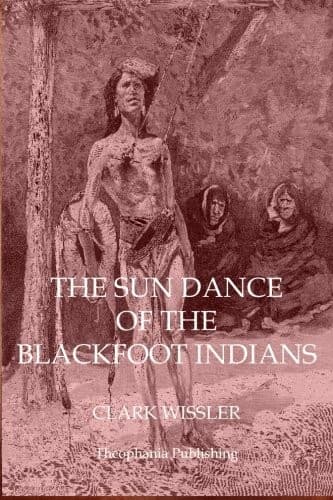
The Sun Dance of the Blackfoot IndiansWissler, Clark
Religion
The Sun Dance of the Blackfoot Indians
Wissler, Clark
Siksika Indians; Sun dance
The father and son go to a sweathouse where all the paint is washed off.
This is not the hundred-willow sweathouse and is the fifth sweathouse,
if it were counted. The two men go in and some sagegrass being handed to
the father, he takes off the feathers tied to the son's hair, the hair
necklace, and whistle. After the first opening of the sweathouse he
takes the sagegrass and wipes off the black paint on the son and hands
out through the west side of the sweathouse the necklace, whistle, and
feathers which are to be taken home. At the same time, the two women are
in the ceremonial lodge, the mother caring for the daughter.
When the men have completed the sweathouse ceremony they go to the
medicine woman's tipi. The father and his wife wrap up the natoas and
place it in the badger skin. After this is done, they no longer have to
eat sparingly. This ends the ceremony of the medicine woman.
Early the next day she and her husband must obtain the cottonwood brush
with which the booth for the weather dancers is made. Another man digs
out the place in the booth, making it the same as the smudge place in
the medicine woman's tipi, with the sod on three sides and creeping
juniper on top of it. The fireplace is dug out to the west of the center
post and is made as in the medicine woman's tipi. When going for and
returning the brush, the woman rides one horse and leads the one
dragging her travois. While when the other brush was brought in there
was much shooting and shouting, there are now no demonstrations of any
kind, but absolute silence.
THE WEATHER DANCERS.
Early on the fifth day, a booth is built inside the dancing lodge
opposite the entrance. A slight excavation about six feet square is made
over which is erected a shelter of green cottonwood boughs, open on the
side facing the sun pole. Before the middle of the day, a procession of
one or more men supposed to have power over the weather, attended by
drummers, proceeds by stages from the medicine woman's tipi to this
booth. They pause four times and dance, facing alternately the east and
the west. They hold whistles of bone in their mouths, which are sounded
in unison with the dancing. The procession is of two transverse lines,
the dancers, in front, the drummers and singers behind. A great deal of
dancing is done between the entrance to the dancing lodge and the booth.
At intervals during the day they stand before the booth and dance to the
east and west: the drummers are now stationed on the south side of the
booth where women also assemble for the singing. The dancing is chiefly
an up and down movement produced by flexing the knees, the eyes are
directed toward the sun and wing-like movements of the hands are made in
the same direction. The dancers wear breechcloth and moccasins and
usually a robe around the waist. Their faces and bodies are painted
according to their own medicines and medicine objects worn on their
heads.
Public-domain text, read in full here on John Shaqi.
Reviews
Reviews
No reviews yet
Be the first to share your thoughts on this work.
Join the Discussion
Join the discussion
Sign in to leave a comment or review.
Sign InorCreate an account