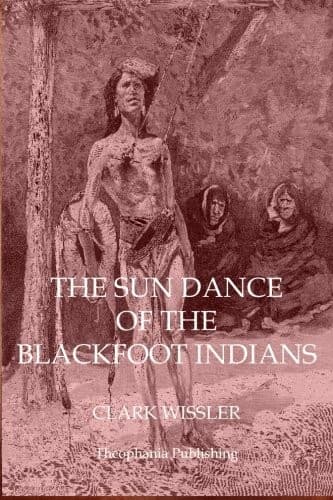
The Sun Dance of the Blackfoot IndiansWissler, Clark
Religion
The Sun Dance of the Blackfoot Indians
Wissler, Clark
Siksika Indians; Sun dance
[15] This series, Vol. 11, 365-474.
THE TORTURE CEREMONY.
The torture feature, especially prominent in the ceremonies of the
Mandan, Hidatsa, and Dakota, was formerly given a place among the
dancing lodge ceremonies of the Blackfoot. The information we have seems
to indicate that this ceremony had not become thoroughly adjusted to its
place in this series at the time of its prohibition by the United States
and Canadian governments. The claim is made by some of the Piegan that
it was borrowed from the Arapaho and was not looked upon with much
favor. As one man expressed it, "None of those taking the cutting lived
to reach old age." It was said that a few Blackfoot warriors once
visited the Arapaho at the time of their sun dance where they were put
through the cutting ceremony. According to the Blackfoot mode of
thought, this means that the medicine rites (and rights) were
transferred to them. When they returned, they induced others to take the
cutting, to whom, of course, the rites were transferred. Whether this
historical statement is accurate or mythical, we have no means of
knowing, but we are inclined to give it some weight as evidence. It
seems, however, that warriors took the cutting because of a vow, similar
to that of the medicine woman. Sometimes a man dreamed that the sun
required it of him. The giving of property and the conditions of the
transfer were the same as for "cutting the thong," though we have no
information that "catching" was permitted. Such may, however, have been
tolerated.
The men taking the cutting were nude to the belt. Sage was tied around
the wrists and ankles. The hair hung down, held in place by a wreath of
cedar (some informants say sage). They were painted white. Rows of spots
in blue extended down the sides of the face, over the shoulders and down
the arms. Wavy lines of the same color were also drawn down the arms. A
circle representing the sun, was made on the breast, also upon the chin
and probably on the back opposite the one over the heart. On the
forehead was another circle representing the moon. Other informants say
a crescent moon in black was used instead of these circles.
Public-domain text, read in full here on John Shaqi.
Reviews
Reviews
No reviews yet
Be the first to share your thoughts on this work.
Join the Discussion
Join the discussion
Sign in to leave a comment or review.
Sign InorCreate an account