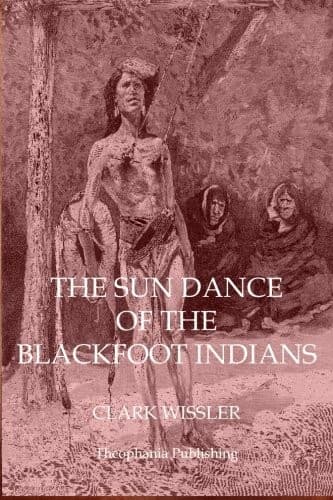
The Sun Dance of the Blackfoot IndiansWissler, Clark
Religion
The Sun Dance of the Blackfoot Indians
Wissler, Clark
Siksika Indians; Sun dance
Again, it must be noted that women who do not feel equal to the
responsibility of the medicine woman's office, make a vow to announce
publicly their virginity or faithfulness to their marriage vows, as the
case may be, though for an unmarried woman to make such a pledge is the
exception. This is spoken of as "the going forward to the tongues," the
full meaning of which will appear later. The manner and occasion of
making this vow are in most respects similar to the preceding. At a
certain stage of the sun dance proceedings, all the women who made such
a promise to the sun, come forward and make their statements subject to
the challenge of any man present. This bears some resemblance to the
virginity tests of the Dakota, but applies more particularly to married
women and marital virtue than otherwise.
Naturally, the number of women making promises of this kind was much
greater than for the more important ceremony. Thus, we have a custom of
calling upon the sun in time of need which is an almost universal
practice, a more restricted form of such appeal peculiar to women in so
far that sexual morality is a necessary qualification, the more specific
vow of "going forward to the tongues", and the exceptional vow to
perform the medicine woman's functions at the sun dance, a fair
illustration of the way in which most complex folk ceremonies are
supported by a pyramid of less and less differentiated practices.
In passing, it should be noted that when the vow is made to perform the
medicine woman's functions, it is literally an obligation to purchase a
natoas bundle, or if already the owner of a bundle, to perform its
ritual.[3] A woman may own more than one of these bundles at a time;
indeed, we have heard of a woman purchasing new ones at several
successive sun dances. This purchase is a fundamental feature in all
bundle ceremonies to which the sun dance bundle offers no exception.
On the other hand, the vow means more than the mere purchase of a
bundle. We are told that the requirement as to virtue holds strictly for
the vow and the tongue ceremony. A woman can buy a natoas in the
ordinary sense and have it transferred with the ritual even though
she has not been true to her husband. We are reminded that
Scabby-round-robe's wife[4] was not true to her former husband and that
when her husband received a beaver bundle there went with it a natoas
and accessories; but that while she could use them by virtue of her
relation to a beaver bundle, she was not competent to make a vow and
initiate a sun dance.[5] This is consistent with the tradition that the
natoas was once bought from a beaver bundle by a woman who gave the sun
dance for that year and used instead of a wreath of juniper as in former
ceremonies. It also throws some light on the relation of the natoas to
the beaver and the sun dance rituals.
FOOTNOTES:
[3] This series, volume 7, 215.
[4] This series, vol. 2, 83.
Public-domain text, read in full here on John Shaqi.
Reviews
Reviews
No reviews yet
Be the first to share your thoughts on this work.
Join the Discussion
Join the discussion
Sign in to leave a comment or review.
Sign InorCreate an account