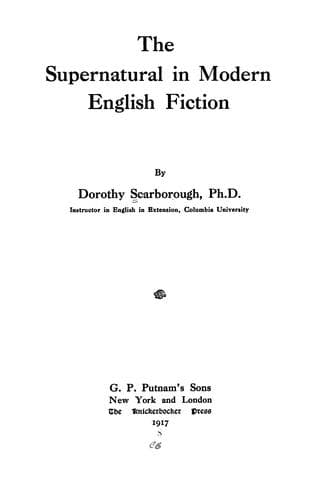
The Supernatural in Modern English Fiction — John Shaqi
The Supernatural in Modern English FictionScarborough, Dorothy
History
The Supernatural in Modern English Fiction
Scarborough, Dorothy
English fiction -- History and criticism; Supernatural in literature
The pages of the Gothic novel are smeared with gore and turn with
ghostly flutter. The conversation is like nothing on land or sea or
in the waters under the earth, for the tadpoles talk like Johnsonian
whales and the reader grows restless under Godwinistic disquisitions.
The authors are almost totally lacking in a sense of humor, yet the
Gothic novel, taken as a whole, is one of the best specimens of
unconscious humor known to English literature.
=Conclusion.= Perhaps the most valuable contribution that the Gothic
school made to English literature is Jane Austen's inimitable satire
of it, _Northanger Abbey_. Though written as her first novel and sold
in 1797, it did not appear till after her death, in 1818. Its purpose
is to ridicule the Romanticists and the book in itself would justify
the terroristic school, but she was ahead of her times, so the editor
feared to publish it. In the meantime she wrote her other satires on
society and won immortality for her work which might never have been
begun save for her satiety of medieval romances. The title of the story
itself is imitative, and the well-known materials are all present,
yet how differently employed! The setting is a Gothic abbey tempered
to modern comfort; the interfering father is not vicious, merely
ill-natured; the pursuing, repulsive lover is not a villain, only a
silly bore. The heroine has no beauty, nor does she topple into sonnets
nor snatch a pencil to sketch the scene, for we are told that she has
no accomplishments. Yet she goes through palpitating adventures mostly
modelled on Mrs. Radcliffe's incidents. She is hampered in not being
supplied with a lover who is the unrecognized heir to vast estates,
since all the young men in the county are properly provided with
parents.
The delicious persiflage in which Jane Austen hits off the fiction of
the day may be illustrated by a bit of conversation between two young
girls.
"My dearest Catherine, what have you been doing with yourself all
the morning? Have you gone on with _Udolpho_?"
"Yes; I have been reading it ever since I woke, and I have got to
the black veil."
"Are you, indeed? How delightful! Oh, I would not tell you what is
behind that black veil for the world! Are you not wild to know?"
"Oh, yes, quite! What can it be? But do not tell me--I would not be
told on any account. I know it must be a skeleton; I am sure it is
Laurentina's skeleton. Oh, I am delighted with the book! I should
like to spend my whole life reading it, I assure you. If it had not
been to meet you, I would not have come away from it for the world."
"Dear creature! How much obliged I am to you; and when you have
finished _Udolpho_, we will read _The Italian_ together; and I have
made out a list of ten or twelve more of the same kind for you."
"Have you, indeed? How glad I am! What are they all?"
Public-domain text, read in full here on John Shaqi.
Reviews
Reviews
No reviews yet
Be the first to share your thoughts on this work.
Join the Discussion
Join the discussion
Sign in to leave a comment or review.
Sign InorCreate an account