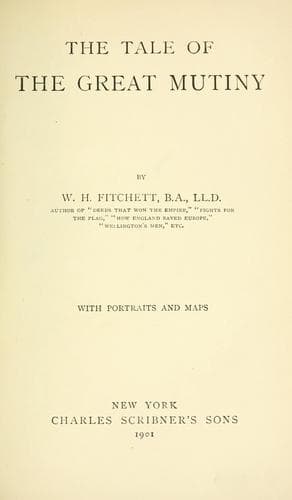
The Tale of the Great MutinyFitchett, W. H. (William Henry)
History
The Tale of the Great Mutiny
Fitchett, W. H. (William Henry)
India -- History -- Sepoy Rebellion, 1857-1858
One survivor has left a record of that dreadful voyage. He was in the
boat that first grounded and was boarded by the Sepoys. He describes
how the passengers were shot, and how “Major Robertson, seeing no hope,
begged the ladies to come into the water rather than fall into their
hands. While the ladies were throwing themselves into the water I
jumped into the boat, took up a loaded musket, and, going astern, shot
a Sepoy.... Mr. and Mrs. Fisher were about twenty yards from the boat;
he had his child in his arms, apparently lifeless. Mrs. Fisher could not
stand against the current; her dress, which acted like a sail, knocked
her down, when she was helped up by Mr. Fisher.... Early the next morning
a voice hailed us from the shore, which we recognised as Mr. Fisher’s.
He came on board, and informed us that his poor wife and child had been
drowned in his arms.”
For skill, daring, and promptitude, nothing exceeded the fashion in which
the incipient mutiny at Multan was trampled out. At no other post were
the conditions more perilous. The garrison consisted of a troop of native
horse-artillery, two regiments of native infantry, and the 1st Irregular
Cavalry; the only English troops were 50 artillerymen in charge of the
magazine. Here, then, were 50 British artillerymen, without guns, opposed
to over 3000 Sepoys—horse, foot, and artillery!
The decisive factor in the problem was the character of the British
commander, Major Chamberlain. His strong will and genius for command
held the 1st Irregular Cavalry steady. They were Hindus from the
neighbourhood of Delhi, with a full measure of the superstition and pride
of caste which swept away other regiments. But they believed in their
commander. He swayed their imaginations as with a touch of magic. The
spell of his looks and voice, his imperious will, overbore the impulse to
revolt. His men declared they would follow him to the death! Chamberlain
resolved to disarm the other native regiments, and he performed the
perilous feat, not only with miraculous audacity, but with a miraculous
nicety of arrangement.
The 2nd Punjaub Infantry and the 1st Punjaub Cavalry were to arrive at
the station on a given day. They were native troops, but could—for the
moment at least—be trusted. The new troops came in at nightfall. At 4
A.M. the next morning the two Sepoy regiments and a troop of native
artillery were marched out as if for an ordinary parade. They were
suddenly halted; the Punjaub troops quietly marched betwixt them and
their lines; the fifty English gunners took their places beside the guns
of the native artillery, and a little band of Sikh cavalry that could be
trusted rode up to the flank of the guns.
Public-domain text, read in full here on John Shaqi.
Reviews
Reviews
No reviews yet
Be the first to share your thoughts on this work.
Join the Discussion
Join the discussion
Sign in to leave a comment or review.
Sign InorCreate an account