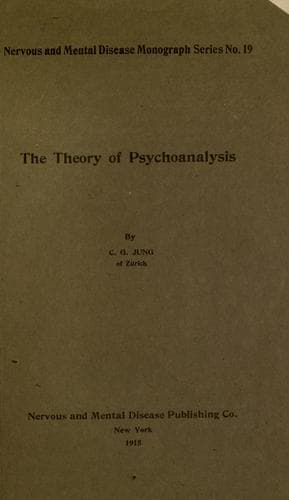
The Theory of PsychoanalysisJung, C. G. (Carl Gustav)
Science
The Theory of Psychoanalysis
Jung, C. G. (Carl Gustav)
Neuroses; Psychoanalysis; Psychology, Pathological; Sex
Our opponents also call hysteria a psychogenic disease. We believe that
we have discovered the etiological determinants of this disease and we
present, without fear, the results of our investigation to open
criticism. Whoever cannot accept our results should publish his own
analyses of cases. So far as I know, that has never been done, at least
not in European literature. Under these circumstances, critics have no
right to deny our conclusions a priori. Our opponents have likewise
cases of hysteria, and those cases are surely as psychogenic as our own.
There is nothing to prevent their pointing out the psychological
determinants. The method is not the real question. Our opponents content
themselves with disputing and reviling our researches, but they do not
point out any better way.
Many other critics are more careful and more just, and do admit that we
have made many valuable observations, and that the associations of ideas
given by the psychoanalytic method will very probably stand, but they
maintain that our point of view is wrong. The alleged sexual phantasies
of childhood, with which we are here chiefly concerned, must not be
taken, they say, as real sexual functions, being obviously something
quite different, since at the approach of puberty the characteristic
peculiarities of sexuality are acquired.
This objection, being calmly and reasonably made, deserves to be taken
seriously. Such objections must also have occurred to every one who has
taken up analytic work, and there is reason enough for deep reflection.
The Conception of Sexuality
Public-domain text, read in full here on John Shaqi.
Reviews
Reviews
No reviews yet
Be the first to share your thoughts on this work.
Join the Discussion
Join the discussion
Sign in to leave a comment or review.
Sign InorCreate an account