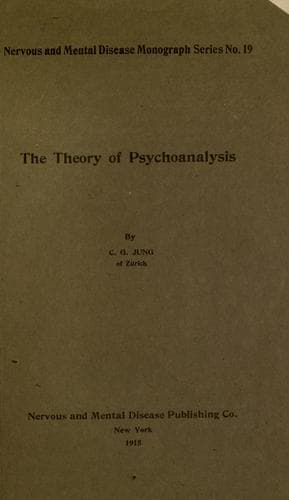
The Theory of PsychoanalysisJung, C. G. (Carl Gustav)
Science
The Theory of Psychoanalysis
Jung, C. G. (Carl Gustav)
Neuroses; Psychoanalysis; Psychology, Pathological; Sex
It is unnecessary to trouble you with instances of this phenomenon. It
is an every-day experience that our emotions are never at the level of
our reasoning. It is exactly the same with such a patient, only with
greater intensity. He may perhaps believe that, save for his neurosis,
he is a normal person, and hence adapted to the conditions of life. He
does not suspect that he has not relinquished certain childish
pretensions, that he still carries with him, in the background,
expectations and illusions which he has never rendered conscious to
himself. He cultivates all sorts of favorite phantasies, which seldom
become conscious, or at any rate, not very often, so that he himself
does not know that he has them. They very often exist only as emotional
expectations, hopes, prejudices, etc. We call these phantasies,
unconscious phantasies. Sometimes they dip into the peripheral
consciousness as quite fugitive thoughts, which disappear again a moment
later, so that the patient is unable to say whether he had such
phantasies or not. It is only during the psychoanalytic treatment that
most patients learn to observe and retain these fleeting thoughts.
Although most of the phantasies, once at least, have been conscious in
the form of fleeting thoughts and only afterwards became unconscious, we
have no right to call them on that account “conscious,” as they are
practically most of the time unconscious. It is therefore right to
designate them “unconscious phantasies.” Of course there are also
infantile phantasies, which are perfectly conscious and which can be
reproduced at any time.
Footnote 7:
Jahrbuch für psychoanalytische und psychopathologisch Forschungen, Bd.
I.
Footnote 8:
Am. Jour. Psychol., April, 1910.
CHAPTER V
The Unconscious
The sphere of the unconscious infantile phantasies has become the real
object of psychoanalytic investigation. As we have previously pointed
out, this domain seems to retain the key to the etiology of neurosis. In
contradistinction with the trauma theory, we are forced by the reasons
already adduced to seek in the family history for the basis of our
present psychoanalytic attitude. Those phantasy-systems which patients
exhibit on mere questioning are for the most part composed and
elaborated like a novel or a drama. Although they are greatly
elaborated, they are relatively of little value for the investigation of
the unconscious. Just because they are conscious, they have already
deferred over-much to the claims of etiquette and social morality. Hence
they have been purged of all personally painful and ugly details, and
are presentable to society, revealing very little. The valuable, and
much more important phantasies are not conscious in the sense already
defined, but are to be discovered through the technique of
psychoanalysis.
Public-domain text, read in full here on John Shaqi.
Reviews
Reviews
No reviews yet
Be the first to share your thoughts on this work.
Join the Discussion
Join the discussion
Sign in to leave a comment or review.
Sign InorCreate an account