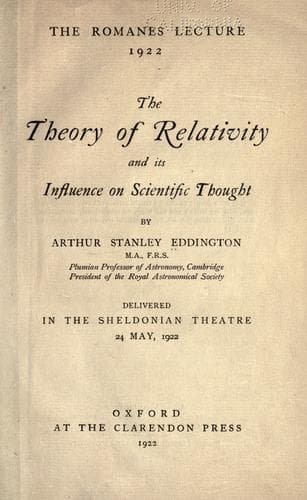
The theory of relativity and its influence on scientific thoughtEddington, Arthur Stanley, Sir
Philosophy
The theory of relativity and its influence on scientific thought
Eddington, Arthur Stanley, Sir
Relativity (Physics); Science -- Philosophy
The discovery, or one should rather say the rediscovery, of the world of
four dimensions is due to Minkowski. Einstein had worked out fully the
relations between the frames of space and time for observers with
different motions. To the genius of Minkowski we owe the realization
that these frames are merely systems of partitions arbitrarily drawn
across a four-dimensional world which is common to all observers.
There is a strange delusion that the fourth dimension must be something
wholly beyond the conception of the ordinary man, and that only the
mathematician can be initiated into its mysteries. It is true that the
mathematician has the advantage of understanding the technical machinery
for solving the problems which may arise in studying the world of four
dimensions; but as regards the conception of the four dimensions of the
world his point of view is the same as that of anybody else. Is it
supposed that by intense thought he throws himself into some state of
trance in which he perceives some hitherto unsuspected direction
stretching away at right angles to length, breadth, and thickness? That
would not be much use. The world of four dimensions, of which we are now
speaking, is perfectly familiar to everybody. It is obvious to every
one--even to the mathematician--that the world of solid and permanent
_objects_ has three dimensions and no more; that objects are arranged in
a threefold order, which for any particular individual may be analysed
into right-and-left, backwards-and-forwards, up-and-down. But it is no
less obvious to every one that the world of _events_ is of four
dimensions; that events are arranged in a fourfold order, which in the
experience of any particular individual will be analysed into
right-and-left, backwards-and-forwards, up-and-down, _sooner-and-later_.
The subject of our study is external nature, which is a world of events,
common to all observers but represented by them differently in their
parochial frames of space and time; it is obvious to the most
commonplace experience that this absolute world contains a fourfold
order.[2]
The news that the events around us form a world of four dimensions is as
stale as the news that Queen Anne is dead. The reason why the relativist
resurrects this ancient truism is because it is only in this undissected
combination of four dimensions that the experiences of all observers
meet. In our own experience one dimension is sharply separated from the
other three and is distinguished as time; but our experience is solely
terrestrial, and if we insist on building the scheme of nature on purely
terrestrial experience we are limiting ourselves to the mediaeval
geocentric system of the world.
Public-domain text, read in full here on John Shaqi.
Reviews
Reviews
No reviews yet
Be the first to share your thoughts on this work.
Join the Discussion
Join the discussion
Sign in to leave a comment or review.
Sign InorCreate an account