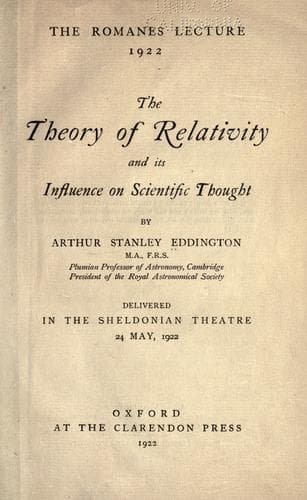
The theory of relativity and its influence on scientific thoughtEddington, Arthur Stanley, Sir
Philosophy
The theory of relativity and its influence on scientific thought
Eddington, Arthur Stanley, Sir
Relativity (Physics); Science -- Philosophy
We go beyond Copernicus nowadays, and are not content with a visit to
the sun. Why choose the sun rather than some other star in order to
obtain an undistorted view of things? The astronomer now places himself
so as to travel with the centre of gravity of the stellar universe, and
is not even then quite satisfied. The physicist dreams of a land of
Weissnichtwo, which shall be truly at rest in the ether. We realize the
distortion imported into the world of nature by the parochial standpoint
from which we observe it, and we try to place ourselves so as to
eliminate this distortion--so as to observe that which actually is. But
it is a vain pursuit. Wherever we pitch our camera, the photograph is
necessarily a two-dimensional picture distorted according to the laws of
perspective; it is never a true semblance of the building itself.
We must try another plan. I do not think we can ever eliminate
altogether the human element in our conception of nature; but we can
eliminate a particular human element, namely, this framework of space
and time. If our thought must be anthropocentric, it need not be
geocentric. Nor are we permanently better off if we merely substitute
the space-time frame of some other star or standard of motion. We must
leave the frame entirely indeterminate. When we do that, we find that
the world common to all observers--in which each observer traces a
different space-time frame according to his own outlook--is a world of
four dimensions. When we look at any object, say a chair, the impression
on our eyes is a two-dimensional picture depending on the position from
which we are looking; but we have no difficulty in conceiving of the
chair as a solid object, not to be identified with any one of our
two-dimensional pictures of it, but giving rise them all as the position
of the observer is varied. We must now realize that this solid chair in
three dimensions is itself only an appearance, which changes according
to the motion of the observer, and that there is a super-object in
four-dimensions, not to be identified with the three-dimensional chair
in Ptolemy's scheme, or the same chair in Copernicus's scheme, but
giving rise to both these appearances. The synthesis of a
three-dimensional chair from a number of flat pictures is easy to us
because we are accustomed to assume different positions in rapid
succession; indeed our two eyes give us slightly different points of
view simultaneously. By sheer necessity our brains have been forced to
construct the conception of the solid chair to combine these changing
appearances. But we do not vary our motion to any appreciable extent and
our brains have not hitherto been called upon to combine the appearances
for different motions; thus the effort which we now ask the brain to
make is a novel one. That explains why the result seems to transcend our
ordinary mode of thought.
Public-domain text, read in full here on John Shaqi.
Reviews
Reviews
No reviews yet
Be the first to share your thoughts on this work.
Join the Discussion
Join the discussion
Sign in to leave a comment or review.
Sign InorCreate an account