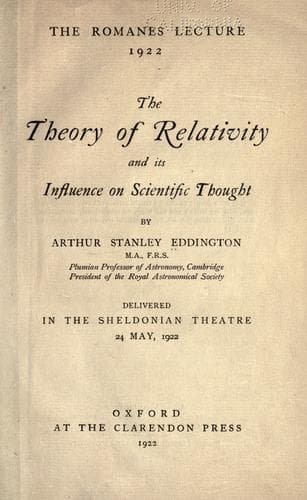
The theory of relativity and its influence on scientific thoughtEddington, Arthur Stanley, Sir
Philosophy
The theory of relativity and its influence on scientific thought
Eddington, Arthur Stanley, Sir
Relativity (Physics); Science -- Philosophy
We have been accustomed to regard the enduring world as composed of a
continuous succession of instantaneous states, as though the world of
events were _stratified_. Each event is supposed to lie in a definite
instant or stratum, and the orderly succession of these strata makes up
the whole of reality. The instant 'now' represents one such stratum
running throughout the universe. Indeed we are accustomed to extend it
beyond the universe, and we even use the word 'now' with reference to
the existence of those who have passed away from the material world. The
investigations of the relativity theory show incontrovertibly that this
supposed stratification is an illusion; there is not the slightest
evidence for such a view of world-structure. The instantaneous state,
which we have hitherto taken to be a natural stratum in the
four-dimensional world of events, is merely an arbitrary partition
created by ourselves to correspond with our geocentric outlook. We can
take a differently inclined partition,[3] that is to say, a section
which includes on the one side of us events which happened a little
while ago and on the other side of us events which have not yet
happened; such a farcical combination is in every way equivalent to our
so-called instantaneous state, and indeed it _is_ an instantaneous state
according to the outlook of some non-terrestrial observer with suitably
assigned motion.
It is so contrary to our natural prejudices to recognize that the
world-wide instant now is created by ourselves and has no existence
apart from our geocentric outlook, that I will spend a few moments
trying to show its artificiality. When I say that I am conscious of an
instant now, I am only conscious of it in so far as it is HERE--inside
me. What then has led me to imagine that there exists a continuation of
it outside me? It is because I look out on the world and see various
events happening 'now', so that I jump to the conclusion that this
instant of which I am conscious has to be extended to include
them. But that idea is another inheritance from the dark ages,
overthrown by Römer in 1675. It is not the events themselves but the
sense-impressions to which they give rise which are happening in the
instant now. So my justification for placing the events outside me in
the instants of which I am conscious has entirely disappeared.
Unfortunately, however, the crude outlook was not abolished, but patched
up; it was found that the immediate difficulties could be met by
locating the external events not in the instant of our visual perception
of them but in an instant which we had experienced a little time
back--allowing, as we say, for the time of propagation of light. Thus
our instants were still made to extend through space; but they were
carried like partitions among the events by an artificial process of
computation, and no longer by immediate intuition. The relativity theory
recognizes these _worldwide instants_ for what they are--artificial
Public-domain text, read in full here on John Shaqi.
Reviews
Reviews
No reviews yet
Be the first to share your thoughts on this work.
Join the Discussion
Join the discussion
Sign in to leave a comment or review.
Sign InorCreate an account