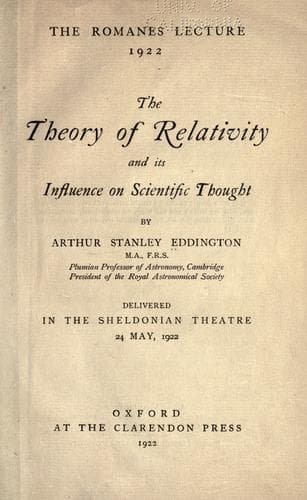
The theory of relativity and its influence on scientific thoughtEddington, Arthur Stanley, Sir
Philosophy
The theory of relativity and its influence on scientific thought
Eddington, Arthur Stanley, Sir
Relativity (Physics); Science -- Philosophy
partitions constructed for purposes of calculation. I may add that it in
no way tampers with the _local instants_ which form the stream of our
consciousness; it fully recognizes that the chain of events in such a
time-succession is a series of an entirely distinctive character from
the succession of points along a line in space. Those who suspect that
Einstein's theory is playing unjustifiable tricks with time should
realize that it leaves entirely untouched that time-succession of which
we have intuitive knowledge, and confines itself to overhauling the
artificial scheme of time which Römer first introduced into physics.
The study of the four-dimensional world of events gives us a new insight
into the processes of nature because it removes the irrelevant
stratification in a particular direction--the instantaneous
states--which we have so unnecessarily introduced in our customary
outlook. When this stratification is ignored we are enabled to see the
processes in their simplest aspect, though not, of course, in their most
familiar aspect. We must distinguish between simplicity and familiarity;
a pig may be most familiar to us in the form of rashers, but the
_unstratified_ pig is a simpler object of study to the biologist who
wishes to understand how the animal functions.
I will conclude this part of the argument with an experimental
application which illustrates the power of Einstein's method. Much study
has of late been given to electrons moving with very high speeds; for
example, the β particles shot off from radioactive substances are
negative electrons which sometimes attain speeds of 100,000 miles a
second. It is found by experiment that the rapid motion produces an
increase of mass of these particles. I want to show that the theory of
relativity gives a very simple explanation of just how this increase of
mass occurs. But I must first remark that an explanation had been
previously given which had generally been accepted as satisfactory. The
phenomenon was actually predicted by J. J. Thomson before relativity was
thought of; because, assuming that the mass of a particle is of
electrical origin, an application of Maxwell's equations shows that it
ought to increase with velocity. But the precise law of increase cannot
be predicted on this basis, since various plausible assumptions lead to
slightly different results. Moreover, Maxwell's equations are after all
only empirical laws, with a mystery of their own; it was a notable
advance to connect the change of mass at high speeds with other
phenomena whose strangeness has disappeared by long familiarity, but
there is still scope for a more far-reaching explanation. Einstein takes
us straight to the root of the mystery, and he clears up one point which
was misleading, if not actually wrong, in the older explanation. The
change of mass does not in any way depend on whether the mass is of
electrical origin or not; it arises simply from the fact that mass is a
Public-domain text, read in full here on John Shaqi.
Reviews
Reviews
No reviews yet
Be the first to share your thoughts on this work.
Join the Discussion
Join the discussion
Sign in to leave a comment or review.
Sign InorCreate an account