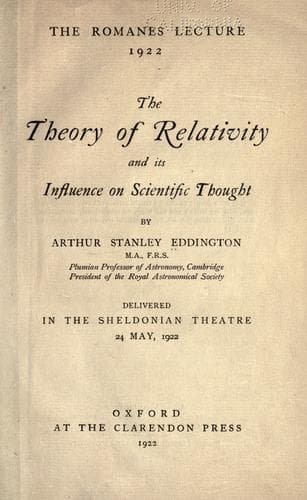
The theory of relativity and its influence on scientific thoughtEddington, Arthur Stanley, Sir
Philosophy
The theory of relativity and its influence on scientific thought
Eddington, Arthur Stanley, Sir
Relativity (Physics); Science -- Philosophy
_relative_ quantity, depending by its definition on the relative
quantities length and time. Let us look at the β particle from its own
point of view; it is just an ordinary electron in no way different from
any other. 'But it is travelling unusually rapidly?' 'That', says the
electron, 'is a matter of opinion. So far as I am aware I am at rest, if
the word "rest" has any meaning. In fact I was just contemplating with
amazement _your_ extraordinary speed of 100,000 miles a second with
which you are shooting past me.' Of course our motion is of no
particular concern to the electron, and it will not modify its
constitution on our account; so it keeps its mass, radius, electric
field, &c., equal to the standard constants applying to electrons in
general. These terms are relative, and refer therefore to some
particular frame of space and time--clearly the frame appropriate to an
electron in self-contemplation, viz. the one with, respect to which it
is at rest. But this frame is not the usual geocentric frame to which
_we_ refer quantities such as length, time, and mass; there is a
difference of 100,000 miles a second between our station of observation
and that of the β particle in self-contemplation. It is a mere matter
of geometry to discover what the β particle's lengths and times become
when referred to the partitions which we have drawn across the world.
But when we calculate the consequential change of mass resulting from
the changes of length and time, we find that it should be increased in
precisely the proportion indicated by the most refined experiments.
The point is that every electron, at rest or in motion, is a perfectly
constant structure; but we distort it by fitting it into the space-time
frame appropriate to our own motion with which the electron has no
concern. The greater our motion with respect to the electron, the
greater will be the distortion. The distortion is not produced by any
physical agency at work in the electron; it is a purely subjective
distortion depending on our transformation of the reference frame of
space and time. This distortion involves a change in our physical
description of the electron in terms of mass, shape, size; and in
particular the change of mass agrees precisely with that found
experimentally.
You see that it is not altogether idle discussing the natural space-time
frames for observers moving with huge velocities. We know of no animate
observers with these speeds; but we do know of inanimate material
objects. Their common resemblance is obscured when we refer them
indiscriminately to our irrelevant geocentric frame; we think they have
altered their properties, varied in mass, and so on; but the resemblance
is restored when we refer each individual to the frame appropriate to
it, and so describe them all in comparable terms.
Public-domain text, read in full here on John Shaqi.
Reviews
Reviews
No reviews yet
Be the first to share your thoughts on this work.
Join the Discussion
Join the discussion
Sign in to leave a comment or review.
Sign InorCreate an account