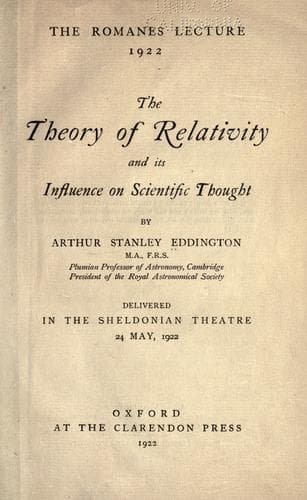
The theory of relativity and its influence on scientific thoughtEddington, Arthur Stanley, Sir
Philosophy
The theory of relativity and its influence on scientific thought
Eddington, Arthur Stanley, Sir
Relativity (Physics); Science -- Philosophy
Our measurements of distance in space are found to be subject to certain
laws--the laws of geometry. But it has now become impossible to regard
the subject of space-geometry as complete in itself. Consider a triangle
formed by three points (or events) in the four-dimensional world; if we
happen to have drawn our instantaneous strata so that the three points
lie in one stratum, then the triangle is a space-triangle and its
properties fall within the scope of our classical geometry. But another
observer will draw his strata in a different direction, and for him the
triangle would be partly in space and partly in time, so that it would
not be a fit subject for space-geometry. The subject of geometry is in a
desperate condition, because Copernicus and Ptolemy not merely disagree
as to the geometry of a configuration; they even disagree as to whether
a given configuration is one to which space-geometry is applicable. It
is clear that to save it we must extend our geometry so as to include
time as well as space. Let me give an illustration of this extension.
The terrestrial observer can have a space-triangle (formed by three
points or events at the same instant) whose sides he can measure with
scales; he can also have a 'time-triangle', formed by three events on
different dates, whose sides he must measure with _clocks_.[4] You all
know the law of the space-triangle--that if you measure with a scale
from _A_ to _B_ and from _B_ to _C_ the sum of the readings is always
_greater_ than the measure from _A_ to _C_. It is not so well known that
there is a precisely analogous law for the time-triangle--that if you
measure with a clock from _A_ to _B_ and from _B_ to _C_ the sum of the
readings is always _less_ than the reading of a clock measuring directly
from _A_ to _C_. In the space-triangle any two sides are together
_greater_ than the third side; in the time-triangle two sides are
together _less_ than the third side.[5] Both these laws must be combined
in our general geometry of four dimensions, so that it will not be quite
so simple a geometry as that to which we are accustomed.[6]
Public-domain text, read in full here on John Shaqi.
Reviews
Reviews
No reviews yet
Be the first to share your thoughts on this work.
Join the Discussion
Join the discussion
Sign in to leave a comment or review.
Sign InorCreate an account