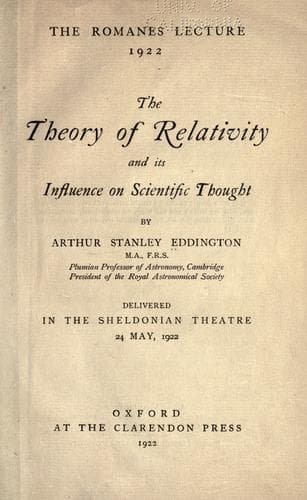
The theory of relativity and its influence on scientific thoughtEddington, Arthur Stanley, Sir
Philosophy
The theory of relativity and its influence on scientific thought
Eddington, Arthur Stanley, Sir
Relativity (Physics); Science -- Philosophy
But the point to which I would especially direct attention is this.
Evidently the proposition which I have given you about time-triangles
cannot be dissociated from the corresponding proposition about
space-triangles. When we give up the mediaeval geocentric standpoint, we
must recognize that they belong to one geometry, of which our ordinary
space-geometry is only a part or projection. But if you examine the
proposition about time-triangles, you will see that it is a statement
about the behaviour of clocks when they move about, a subject which
obviously comes under the heading of mechanics. When we deal with the
four-dimensional world we can no longer distinguish between geometry and
mechanics. They become the same subject. When we have completely
mastered the geometry of the world of events, we shall have inevitably
learnt the mechanics of it. That is why Einstein, studying the geometry
of the world and discovering that it was strictly non-Euclidean, found
that he was at the same time studying the mechanical force of
gravitation. And when he had made up his mind which of the possible
varieties of non-Euclidean geometry was obeyed, and so settled the laws
of the new geometry, the same decision settled the law of gravitation--a
law approximating to, but not identical with, the law which Newton had
given.
Here a wide vista opens before us. We see that two great divisions of
mathematical physics, viz. geometry and mechanics, have met in the
four-dimensional world. It is not merely that mechanical problems can be
treated by formulae originally belonging to pure geometry; that device
has long been in use. Experimental geometry and mechanics actually
relate to the same subject-matter; and the young student who discovers
experimental laws with ruler and compasses and cardboard figures, and
later goes on to pendulums and spring-balances, is developing a single
subject which cannot be divided any more than the subject of magnetism
can be divided from electricity.
It is through this unification of geometry and mechanics that I should
like to approach the problem of gravitation, showing that a field of
force is a manifestation of the geometry of space and time. But I fear
that that would be too technical; so we will approach it from a
different angle.
Public-domain text, read in full here on John Shaqi.
Reviews
Reviews
No reviews yet
Be the first to share your thoughts on this work.
Join the Discussion
Join the discussion
Sign in to leave a comment or review.
Sign InorCreate an account