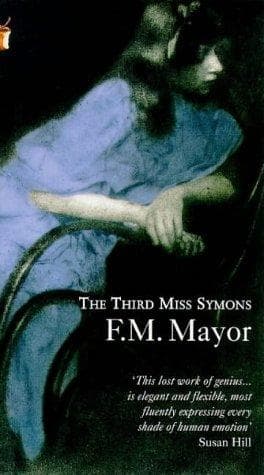
The Third Miss SymonsMayor, F. M. (Flora Macdonald)
General
The Third Miss Symons
Mayor, F. M. (Flora Macdonald)
England -- Social life and customs -- 19th century -- Fiction; Single women -- Fiction
The clergyman, the lady, and all the other workers, were earnest,
enthusiastic, high-minded, and full of common sense. Henrietta was not
one of these things. She was also very inaccurate, unpunctual, and
forgetful, and if her failings were pointed out to her in the gentlest
way she took offence, not because she was conceited, but because at her
age she was beyond having things pointed out. She stayed at the work six
months, and during that time she was always offended with somebody, and
sometimes with everybody.
The work was conducted more on charity organization lines than was usual
in those days; money was not given without due consideration and
consultation. This was difficult, and required more thinking than
Henrietta cared for, so she saved herself trouble by bestowing five
shillings whenever she wanted, feeling at the bottom of her heart that
if she could not be liked for herself, she would buy liking rather than
not be liked at all. The five shillings, however, did not buy either
gratitude or affection. She had always had a grudging way with people of
a different class from herself, and a conviction, in spite of
indiscriminate alms, that she was being taken in. This infringement of
the rules drove the Vicar to exasperation. His whole heart was in his
work, and Henrietta's disloyalty hindered him at every turn.
"Can't she be asked to give up meddling in the parish?" he said to his
wife.
"No dear, you know she can't, and she is very generous, even if she is
tiresome. She has often been very helpful to you. You ought to be
grateful."
"I'm not grateful," he said, striding about the room; "and then she is
so petty, always these absurd squabbles. She hasn't got a spark of love
for God or man. That's at the root of it all. We don't want a person of
that sort here. If she cared about the people, even if she did pauperize
them, I might think her a fool, but I could respect her; but you know
she doesn't care for a soul but herself."
"I don't think it is that, but she's in great trouble, I'm sure she is.
When you were preaching about sorrow last Sunday, I saw her eyes were
filled with tears."
"Were they?" he said, "I'm sorry. But look here, dear, I don't think
this sort of work ought to be used as a soothing syrup, or as a
rubbish-shoot for loafers, who don't know what else to do. If people
aren't doing it because they think it's the greatest privilege in the
world to be allowed to do it, I can't see that they do much good."
"I think you're too hard on her."
"Am I? I expect I am. I know I'm fagged to death. She gives Mrs.
Wilkins pounds on the sly, which the old lady's been transforming into
gin, and then when I explain the circumstances and implore her to leave
well alone, she talks my head off with a torrent of incoherent
statements, which have nothing whatever to do with the point."
Public-domain text, read in full here on John Shaqi.
Reviews
Reviews
No reviews yet
Be the first to share your thoughts on this work.
Join the Discussion
Join the discussion
Sign in to leave a comment or review.
Sign InorCreate an account