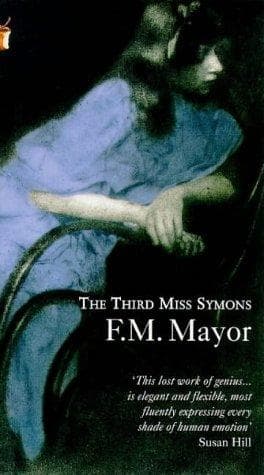
The Third Miss SymonsMayor, F. M. (Flora Macdonald)
General
The Third Miss Symons
Mayor, F. M. (Flora Macdonald)
England -- Social life and customs -- 19th century -- Fiction; Single women -- Fiction
"Now, dearest," said Herbert firmly, "I dare say you and Etta will like
a little rest. Suppose I and the boys get a walk in the country; and
don't wait lunch for us, you know. I dare say we can get something at
one of those little wine places one sees about."
They managed to construct a sentence for the priest, who was standing
nodding by them: "Are there any pretty walks in the neighbourhood?"
Smiling genially, he pointed to an answer which the phrase-book
translated: "The landscape presents a grandiose panorama."
Evelyn gave the priest a contribution to his mission church. He was
overwhelmed with surprise and pleasure at this good action on the part
of a heretic, it added to his pleasure that she was such a beautiful
heretic, and when, as they said good-bye, Evelyn wished that they might
meet again, he replied, with his face all over smiles, "I hope perhaps
in Paradise"; he could not speak with absolute certainty. Something in
the way he said it brought tears to Evelyn's eyes, and Henrietta, who
was looking on and listening, thought with a little envy that none of
the many priests or pastors, few even of the laity she had encountered
in her wanderings, had ever hoped to meet _her_ again either in heaven
or on earth. After many affectionate bows, he said good-bye.
The sisters were scarcely half an hour buying picture postcards (there
had been nothing else to do, so they had bought more picture postcards
than it seemed possible could be bought), when rain came on--not gentle
English rain, but the fierce cataracts of Italy, let loose for the rest
of the day. Back came Herbert and the boys, who had somehow missed the
grandiose panorama. It had, in fact, been created entirely out of
politeness by the priest.
After lunch, which they prolonged to its farthest limit, there was
nothing for it but the salon, a small room, with its window darkened by
the verandah outside. Madame brought in yesterday's _Tribuna_, and they
found an illustrated catalogue of hotels in Dresden. Oh, that three
hours and a half! The boys and Herbert would have been content to sit
with their shoulders hutched up, staring at their boots, going every
quarter of an hour to the front-door to see if it were raining as hard
there as it was out of the salon window, and Evelyn only wanted to be
left in silence with her headache. But Henrietta would tease the boys.
Whatever they did do, or whatever they did not do, seemed an occasion
for criticism. Evelyn, to divert attention, burst into long
reminiscences of the days at Willstead. Henrietta combated each
statement with a kind of sneer, as though whatever Evelyn said was bound
to be worthless. Evelyn saw Herbert, who always treated her as if she
were a wonderful queen, casting black looks at Henrietta. At last his
anger came out:
"I don't know why it seems impossible for you to talk to Evelyn with
ordinary civility, Henrietta."
Public-domain text, read in full here on John Shaqi.
Reviews
Reviews
No reviews yet
Be the first to share your thoughts on this work.
Join the Discussion
Join the discussion
Sign in to leave a comment or review.
Sign InorCreate an account