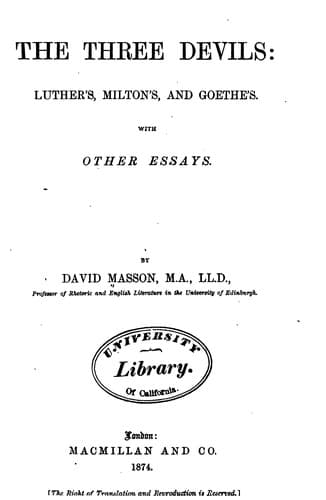
The Three Devils: Luther's, Milton's, and Goethe's; With Other EssaysMasson, David
History
The Three Devils: Luther's, Milton's, and Goethe's; With Other Essays
Masson, David
Devil in literature; Literature -- History and criticism
to the task of representing the Spirit of Evil as he existed six thousand
years later, no longer gifted with the same powers of locomotion, or
struggling for admission into this part of the universe, but plying his
understood function in crowded cities and on the minds of individuals.
So far as the mere fact of Milton's having made Satan the hero of his
epic, or of Goethe's having made Mephistopheles a character in his drama,
qualifies us to speak of the theological opinions of the one or of the
other, we are not entitled to say that either Milton or Goethe believed in
a Devil at all as Luther did. Or, again, it is quite conceivable that
Milton might have believed in a Devil as sincerely as Luther did, and that
Goethe might have believed in a Devil as sincerely as Luther did also, and
yet that, in that case, the Devil which Milton believed in might not have
been the Satan of the _Paradise Lost_, and the Devil which Goethe believed
in might not have been the Mephistopheles of _Faust_. Of course, we have
other means of knowing whether Milton did actually believe in the
existence of the great accursed being whose fall he sings. It is also
plain that Goethe's Mephistopheles resembles Luther's Devil more than
Milton's Satan does in this respect--that Mephistopheles is the expression
of a great deal of Goethe's actual observation of life and experience in
human affairs. Still, neither the fact, on the one hand, that Milton did
believe in the existence of the Evil Spirit, nor the fact, on the other,
that Mephistopheles is an expression for the aggregate of much profound
thinking on the part of Goethe, is of force to obliterate the fundamental
distinction between Luther's Devil, as a biographical reality, and
Milton's Satan and Goethe's Mephistopheles, as two literary performances.
If we might risk summing up under the light of this preliminary
distinction, perhaps the following would be near the truth:--Luther had as
strong a faith as ever man had in the existence and activity of the Evil
Spirit of Scripture: he used to recognise the operation of this Spirit in
every individual instance of evil as it occurred; he used, moreover, to
conceive that this Spirit and he were personal antagonists; and so, just
as one man forms to himself a distinct idea of the character of another
man to whom he stands in an important relation, Luther came to form to
himself a distinct idea of the Devil, and what this idea was it seems
possible to find out by examining his writings. Milton, again, chose the
Scripture personage as the hero of an epic poem, and employed his grand
imagination in realizing the Scripture narrative: we have reason also to
know that he did actually believe in the Devil's existence; and it agrees
with what we know of Milton's character to suppose that the Devil thus
believed in would be pretty much the same magnificent being he has
described in his poem--though, on the whole, we should not say that Milton
Public-domain text, read in full here on John Shaqi.
Reviews
Reviews
No reviews yet
Be the first to share your thoughts on this work.
Join the Discussion
Join the discussion
Sign in to leave a comment or review.
Sign InorCreate an account