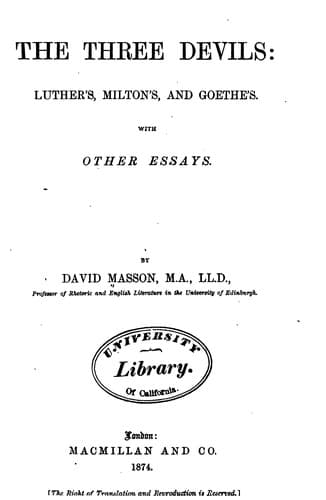
The Three Devils: Luther's, Milton's, and Goethe's; With Other EssaysMasson, David
History
The Three Devils: Luther's, Milton's, and Goethe's; With Other Essays
Masson, David
Devil in literature; Literature -- History and criticism
And here it is that, in proceeding to make up the deficiency of the
external evidence by going to the only other available source of light on
the subject, namely the bequeathed writings of the man himself, we find
ourselves obstructed at the outset by an obvious difficulty, which does
not exist to the same extent in most other cases. We can, with comparative
ease, recognise Burns himself in his works; for Burns is a lyrist, pouring
out his own feelings in song, often alluding to himself, and generally
under personal agitation when he writes. Shakespeare, on the other hand,
is a dramatist, whose function it was not to communicate, but to create.
Had he been a dramatist of the same school as Ben Jonson, indeed--using
the drama as a means of spreading, or, at all events, as a medium through
which to insinuate, his opinions, and often indicating his purposes by the
very names of his _dramatis personæ_ (as Downright, Merecraft, Eitherside,
and the like)--then the task would have been easier. But it is not so with
Shakespeare. Less than almost any man that ever wrote does he inculcate or
dogmatise. He is the very type of the poet. He paints, represents,
creates, holds the mirror up to nature; but from opinion, doctrine,
controversy, theory, he holds instinctively aloof. In each of his plays
there is a "central idea," to use the favourite term of the German
critics--that is, a single thought round which all may be exhibited as
consciously or unconsciously crystallized; but there is no pervading
maxim, no point set forth to be argued or proved. Of none of all the plays
can it be said that it is more than any other a vehicle for fixed articles
in the creed of Shakespeare.
One quality or attribute of Shakespeare's genius we do, indeed, contrive
to seize out this very difficulty of seizing anything--that quality or
attribute of _many-sidedness_ of which we have heard so much for the last
century and a half. The immense variety of his characters and conceptions,
embracing as it does Hamlets and Falstaffs, Kings and Clowns, Prosperos
and Dogberrys, and his apparently equal ease in handling them all, are
matters that have been noted by one and all of the critics. And thus,
while his own character is lost in his incessant shiftings through such a
succession of masks, we yet manage, as it were in revenge, to extract from
the very impossibility of describing him an adjective which does possess a
kind of quasi-descriptive value. It is as if of some one that had baffled
all our attempts to investigate him we were to console ourselves by saying
that he was a perfect Proteus. We call Shakespeare "many-sided;" not a
magazine, nor a young lady at a party, but tells you that; and in adding
this to our list of adjectives concerning him we find a certain
satisfaction, and even an increase of light.
Public-domain text, read in full here on John Shaqi.
Reviews
Reviews
No reviews yet
Be the first to share your thoughts on this work.
Join the Discussion
Join the discussion
Sign in to leave a comment or review.
Sign InorCreate an account