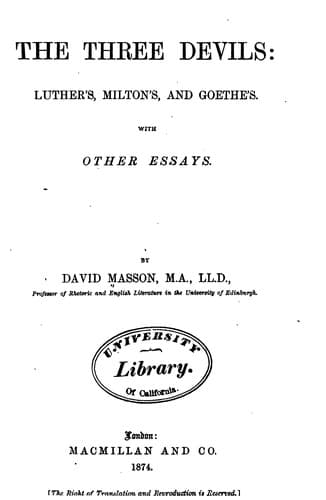
The Three Devils: Luther's, Milton's, and Goethe's; With Other EssaysMasson, David
History
The Three Devils: Luther's, Milton's, and Goethe's; With Other Essays
Masson, David
Devil in literature; Literature -- History and criticism
was a man likely to carry about with him, in daily affairs, any constant
recognition of the Devil's presence. Lastly, Goethe, adopting, for a
different literary effect, the Scriptural and traditional account of the
same being, conceived his Mephistopheles. This Mephistopheles, there is no
doubt, had a real allegoric meaning with Goethe; he meant him to typify
the Evil Spirit in modern civilization; but whether Goethe did actually
believe in the existence of a supernatural intelligence whose function it
is to produce evil is a question which no one will feel himself called
upon to answer, although, if he did, it may be unhesitatingly asserted
that this supernatural intelligence cannot have been Mephistopheles.
From all this it appears that Luther's conception of the Evil Being
belongs to one category, Milton's and Goethe's to another. Let us
consider, _first_, Milton's Satan, _secondly_, Goethe's Mephistopheles,
and, _thirdly_, Luther's Devil.
* * * * *
The difficulties which Milton had to overcome in writing his _Paradise
Lost_ were immense. The gist of those difficulties may be defined as
consisting in this, that the poet had at once to represent a supernatural
condition of being and to construct a story. He had to describe the
ongoings of Angels, and at the same time to make one event follow another.
It is comparatively easy for Milton to sustain his conception of those
superhuman beings as mere objects or phenomena--to represent them flying
singly through space like huge black shadows, or standing opposite to
each other in hostile battalions; but to construct a story in which these
beings should be the agents, to exhibit these beings thinking, scheming,
blundering, in such a way as to produce a likely succession of events, was
enormously difficult. The difficulty was to make the course of events
correspond with the reputation of the objects. To do this perfectly was
literally impossible. It is possible for the human mind to conceive
twenty-four great supernatural beings existing together at any given
moment in space; but it is utterly impossible to conceive what would occur
among those twenty-four beings during twenty-four hours. The value of
time, the amount of history that can be transacted in a given period,
depends on the nature and prowess of the beings whose volitions make the
chain of events; and so a lower order of beings can have no idea at what
rate things happen in a higher. The mode of causation will be different
from that with which they are acquainted.
Public-domain text, read in full here on John Shaqi.
Reviews
Reviews
No reviews yet
Be the first to share your thoughts on this work.
Join the Discussion
Join the discussion
Sign in to leave a comment or review.
Sign InorCreate an account