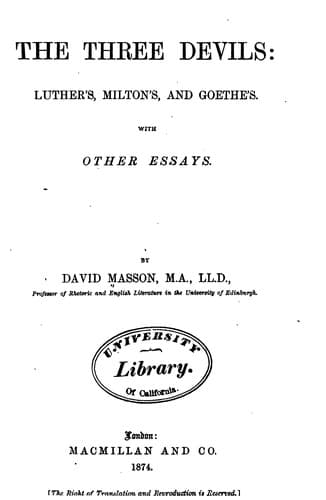
The Three Devils: Luther's, Milton's, and Goethe's; With Other EssaysMasson, David
History
The Three Devils: Luther's, Milton's, and Goethe's; With Other Essays
Masson, David
Devil in literature; Literature -- History and criticism
But it would be cowardice to stop here. The old sea-god Proteus himself,
despite his subtlety and versatility, had a real form and character of his
own, into which he could be compelled, if one only knew the way. Hear how
they served this old gentleman in the Odyssey:
"We at once,
Loud shouting, flew on him, and in our arms
Constrained him fast; nor the sea-prophet old
Called not incontinent his shifts to mind.
First he became a long-maned lion grim;
A dragon then, a panther, a huge boar,
A limpid stream, and an o'ershadowing tree.
We, persevering, held him; till, at length,
The subtle sage, his ineffectual arts
Resigning weary, questioned me and spoke."
And so with _our_ Proteus. The many-sidedness of the dramatist, let it be
well believed and pondered, is but the versatility in form of a certain
personal and substantial being, which constitutes the specific mind of the
dramatist himself. Precisely as we have insisted that Shakespeare's face,
as the best portraits represent it to us, is no mere general face or face
to let, but a good, decided, and even rather singular face, so, we would
insist, he had as specific a character, as thoroughly a way of his own in
thinking about things and going through his morning and evening hours, as
any of ourselves. "Man is only many-sided," says Goethe, "when he strives
after the highest because he _must_, and descends to the lesser because he
_will_;" that is, as we interpret, when he is borne on in a certain noble
direction in all that he does by the very structure of his mind, while, at
his option, he may keep planting this fixed path or not with a sportive
and flowery border. By the necessity of his nature, Shakespeare was
compelled in a certain earnest direction in all that he did; and it is our
part to search through the thickets of imagery and gratuitous fiction amid
which he spent his life, that this path may be discovered. As the lion, or
the limpid stream, or the overshadowing tree, into which Proteus turned
himself, was not a real lion, or a real stream, or a real tree, but only
Proteus as the one or as the other; so, involved in each of Shakespeare's
characters,--in Hamlet, in Falstaff, or in Romeo,--involved in some deep
manner in each of these diverse characters, is Shakespeare's own nature.
If Shakespeare had not been precisely and wholly Shakespeare, and not any
other man actual or conceivable, could Hamlet or Falstaff, or any other of
his creations, have been what they are?
Public-domain text, read in full here on John Shaqi.
Reviews
Reviews
No reviews yet
Be the first to share your thoughts on this work.
Join the Discussion
Join the discussion
Sign in to leave a comment or review.
Sign InorCreate an account